

HARMONIA LUNISOLARIS · ANNI MULTIPLICIS
NOVAE CHRONOGRAPHIA AEVISIDERA AD HORIZONTEM COSMICUM
AEVUM ORDINIS SIDEREA · ENCYCLION SERIES PRIMA · INF-ENC-001 · INFRA NOVUM FIRMAMENTUMThe new calculus of temporal measure inaugurates the passage from the Modern Age of Capital into the Exomodern Age of Stars. Disciplined unto the deep cosmic horizon, the human mind renounces the liquefaction of modernity and every form derived from it. This document promulgates the structure of the new measure, its nature, and the form through which it reclaims the manifold of time.
INDEX THESIUM
I. CRITERIUM TEMPORALE: ARTICLES 1 - 8
II. ANATOMIA SOLARIS: ARTICLES 9 - 12
III. CIRCUITUS STELLARUM ZODIACI: ARTICLES 13 - 16
IV. OCTAVA LUNARIS: ARTICLES 12 - 20
V. ARCUS PLANETARIUS: ARTICLES 21 - 23
VI. INSTRUMENTA FORMALIA: ARTICLES 23 - 27
PROVOCATION · A Critique of The Calendar’s Neutrality
The eons of history are first inhabited by conflicts before Man is able to reflect on the events which transpired thought its arc. In the aftermath of turbulent events, Man gazes into the archive of sociotemporal evolution in pursuit of meaning from strife. Man’s transfixed gaze interprets a higher unity of truth which demands to be named. The act of naming is a constitutive summary that defines the ages of Man. The name itself opens the very territory that it designates. We shall call the historical condition in which modern systems behave outside the scale of ordinary human comprehension and autonomy, while sill penetrating intimate life, EXOMODERNITY. The postindustrial epoch takes its character from the collapse of institutional decadence; from the widening gap between their functions and their forms. The Nation-State retains its territorial symbols, and legal claims to sovereignty as the apparatus of representation. Effective governance has migrated into algorithmic regimes of private arbitration. Extra-jurisdictional financial systems escape the margins of national borders. The Church retains their buildings and liturgical vocabulary, but the formation of a person now occurs in therapeutic markets, or communities operating without institutional recognition. The market retains its self-regulating theology, but actual value concentrates in impersonal platforms unaccountable to public welfare. Modernity’s institutions persist only as visible artifacts while their effective functions have relinquished themselves to unregistered infrastructures. Late modernity produces a condition alongside itself; the outside from which the inside continues to function while its effective operations have already transformed beyond the frame of its registration. Neither the death of the modern order nor its dialectical negation. Its structure is unilateral; the exterior determines the interior without that determination being registered from within.Understanding exomodernity requires understanding the temporal schema that produced it. Time, in the dominant modern account, does not pulse nor does it thicken at certain moments and become thin at others. It does not carry the specific weight that a particular threshold demands. Rather, it is a homogeneous and empty medium. It is a flat, infinitely divisible substrate, extending without differentiation from any point backward into the past and forward into a future that is identical to the present, but deferred. This account of time was enacted at the level of bodily habit and institutional practice before any philosophical justification. The clock, with its equal hours unmarked by season or prayer, installs it at the scale of the body. The calendar, with its administratively determined year-opening and qualitatively undifferentiated units, installs it at the scale of the year. Together, they constitute the temporal architecture within which the dominant civilization's fundamental operation becomes possible. That operation is accumulation. Accumulation requires fungible units: labor-time is sold only insofar as one hour is equivalent to the next, insofar as the time of a winter morning and a summer afternoon carry no intrinsic difference, no irreducible texture, no demand not commensurable with any other unit. The suppression of temporal texture, the flattening of every solar threshold, stellar rising, and lunar phase into the administrative equivalence of one day to any other, is the dominant social form's infrastructure. The calendar is one of the material conditions within which Capital becomes the subject of history.Capital operates as the subject of historical agency with the advent of industrialization. Time approaches a terminal form when the space of experience becomes identical with the horizon of anticipation. It is in this state that the future is legible only as more of the same, when no alternative forms of social organization can be conceived. It is within this condition that truly designates the end of history, and, as such, inaugurates Exomodernity. When the demand for genuine temporal difference can no longer be posed within the dominant frame, it does not disappear.It migrates into the exterior, where it begins to constitute alternative temporalities that the dominant order cannot register from within its narrow field of visibility. The acceleration paradox completes the structure: the dominant temporal order, in its intensifying logic, produces an impoverished, diminishing present. The future, ever more calculable, moves faster and inhabits less. This impoverishment is the structural condition from which the demand for genuine temporal alternatives departs and, in the exterior, begins to be built.Exomodernism, as the formal discipline of constructing forms adequate to the exterior, can be neither ironic nor nostalgic; and cannot project humanist utopias that remain within Capital's temporal parameters. Its formal aesthetic is modern hieratic filtered through an immanent aesthetic of sacred brutalism. The result of this unique mixture is severe, non-ornamental, weighted, material. Its documents function simultaneously as philosophical text, institutional technology, and designed artifacts. Its temporal composition is astronomically differentiated, and its parts constitute a material refusal of vacuous Gregorian enacted at the level of daily life. Every observation of the solstice, rising, or lunar phase is a bodily act inhabiting a temporal architecture in which Capital's mode of historical agency cannot operate with the same frictionless ease. The avant-garde of the 21st century will be high-order. It will be a revitalization of the institution, but voluntary and polycentric. Exomodernism renounces the liquefaction of modernity and its derivative forms. This Encyclical promulgates its account of time.There is no system of measuring time that does not encode a prior decision about what is significant, what is real, and whose account of the real shall be treated as default. As such, no calendar is a neutral object; nor can there be any apolitical method for counting the passage of moments. The activity of keeping time is, by its nature, a social technology of institutional metaphysics. The Gregorian calendar indexed to a specific theological event, organized by a bureaucratic logic of administrative convenience, and presented as though it were the transcendental shape of time itself rather than one particular claim about it. Its months are named for fallen emperors or dead gods no longer worshipped. Its week ends and begins where a specific tradition is required. Its year opens on an administrative date with no concrete meaning, chosen by fiat and ratified by inertia.The Gregorian calendar is the conspiracy of Man against itself by the ruling elite to the advantage of Capital. Of time's volatile nature, it has made a neutered vessel from its composition; domesticating is structure to the positive sum axiom of profit. This flattening has standardized how Man behaves in the contexts of civil society. The creature has forgotten Eternity, the sky, the patterns of the Moon and Sun. Man has forgotten history, and its place within this process. The creature redirects attention to fungible subdivisions of Gregorian time measured in years, months, days, hours, minutes, seconds, and infinitesimal fractions of a second.To uncritically inherit this calendar accepts, at the level of daily experience, the temporal framework of a civilization one may have already abandoned in every other register. Time’s new formal reckoning is grounded in nothing but the empirical motions of celestial bodies. No authority beyond the sky is invoked. No revealed text is required. No tradition is accepted on the basis of tradition as such.The system is astronomically precise and can be validated independently by any person with a clear horizon and a standard ephemeris. As such, it establishes a new discipline of observing what the sky actually does and allowing that observation to organize institutional and personal life. Mythology plays no significant role. The phenomena are sufficient.The practice recovered here is older than astrology. It represents a living practice in genuine concert with the movements of the solar system, movements that governed every serious civilization before the artificial light of modernity rendered the sky invisible.The floor of this system is four acts. Any person who knows which season the Sun is in, which stars rise at dawn, and what phase the moon presents tonight participates in the same temporal framework as every other person who does the same. No institution is required for this. The sky is sufficient. This Encycliture promulgates a novel account of time.and determine what it When the conflicts of history are settled, a name has a constitutive act and does not merely describe the status after understanding is achieved. The name is a category which opens the territory it designates. Late modernity produces a condition alongside itself; the outside from which the inside continues to function while its effective operations have already transformed beyond the frame of its registration. Neither the death of the modern order nor its dialectical negation. Its structure is unilateral; the exterior determines the interior without that determination being registered from within.
They designate intensities but none determine what is actually essential to present.
THESES · SYNTAXIS CHRONOSOPHIA AEVISIDERAE · DOCTRINES OF EXOMODERN CHRONOSOPHY
DOCTRINE I · ON THE NEW CRITERION OF TEMPORAL MEASURE
I. The human science of measuring time is embedded in the social practices of the art of living, knowingly or not, and cannot be reduced to a neutral act.
II. The mechanical time of Capital is homogeneous, but not without form. empty, and annihilating; it is not the only time available to consciousness.
III. The Body knows a time whose organization is prior to the logistics markets coordinated by industrialization and Capital.
IV. The deep history of the universe provides a concrete temporal structure adequate to the measure of the human intellect.
V. The new criterion of temporality provided by the stars restores time’s immanent order and does not impose an arbitrary civil logic upon it.
VI. In this new criterion, the annual cycle is an ontological commitment to growth.
VII. To inhabit the institutional calendar is to reject homogeneous time in daily life as a vague aesthetic supplement.
VIII. Duration is necessary to one’s formative discipline; duration requires a biotemporal calculus that measures what is essential to growth.
DOCTRINE II · SOLAR ANATOMY
IX. The year has four points.
X. The intervals between points are of asymmetric relation.
XI. The year contains three arcs.
XII. Every point is a zero day event in the year’s structure.
DOCTRINE III · CIRCUIT OF FIXED STARS
XIII. The year has four points.
XIV. The intervals between points are of asymmetric relation.
XV. The year contains three arcs.
XVI. Every point is a zero day event in the year’s structure.
DOCTRINE IV · LUNAR OCTAVA
XVII. The Moon returns to the same geometry every 29.5 days.
XVIII. The lunar cycle impresses upon the Body.
XIX. The eight day cycle is called the OCTAVA.
XX. The day has nine solar stations, marked 0 through 8.
DOCTRINE V · PLANETARY ARC
XXI. The planets do not share the same year as the Earth’s.
XXII. Synodic and orbital periods serve differing temporal functions.
XXIII. The Saturn Constant designates a scheduled constitutional review.
DOCTRINE VI · THE FORMAL INSTRUMENTS
IX. A moment in the year is identifiable without Gregorian reference.
X. The system requires geographic calibration.
XI. The annual ephemeris is issued at each C.I.
XII. The Aetates retain their astronomical dating for all members irrespective of latitude.
APOCALYPSIS · POSTULATUM VISIONARIUM ZODIACI SIDEREAION · SYNOPTIC POSTULATE OF THE EXOMODERN ZODIAC
The objects of knowing are distinct from the knower. The immanent properties of dimension, insofar as they become intelligible, occur with and within the subject of knowing. All events pass through the aperture of an observer’s point of reference. In the subjective tropics of knowing and being, all intelligible moments accumulate at the axis of finite reason.In the curved field of Intuition, all transient instants of being and knowing exist as bare facts of occurrence or separation. Temporality is the radiant source generating all action; occurrence is the primitive notion of action in the Abstract and the Real. Space is the necessary crucible of relation delimiting action and object; separation is the necessary category of all things that exist and can be known. Now is the immediate coordinate of temporality and of Occurrence, as Here is the immediate coordinate of Separation and of space. Now discloses an occurrence in time; Here discloses a separation in space. From their conjunction arises the finite Perspective from which the geometry of the world becomes knowable.The present Now is what-is-currently or being in sympathy with action. It burns forward without cessation; it radiates with possibilities gathered inside its furnace. Now is constant, because Occurrence is constant, but a stable idea of the present is never truly Here. In the time that it takes to count just one second and recognize that it is happening, Now has already transitioned into the realm of what once was. The human capacity to apprehend the instant is and will always be secondary to the moment of Occurrence.The future is what is to come or what has yet to become. It appears as a potential “now” that is never fully present. The future becomes the present or not at all. The past absorbs the present, but is always the past. The past persists through its effects and through Memory which haunts the present, thus conditioning the future. The present becomes past and succumbs to the future simultaneously but sustains its status in the Now. The future offers possibility, the past accumulates what has occurred, the present is instantiated by the Real. The Point establishes spatial position, thus disclosing Here. The Point extends itself from Here to another point There. The expansion of the Point into the Line establishes direction and trajectory. The transverse extension of Line expands from length to the Plane. The Plane’s becoming establishes area and width. The Plane’s continuous surface articulates the shape of objects and the foundations of being, in and for itself, with the Real. The extension of the Plane into depth describes the Solid, wherein volume is established. The Solid conceals radiant action in the vessel of a finite body. The finite body encloses the passionate intensity of Now within the interior of the Solid. The Solid is always the possible object of knowing and potentially the subject of knowing when the Solid is the living body.Space is the ocean whose breadth is greater than any continent, vaster than all other bodies of water. Space is the bearer of the stars, their cosmic mother and sovereign over their relations. Temporality sets the spheres of heaven in motion; it is the reason night maintains its course. The differentiation of discernibles is immanent in space and remains in its custody throughout the territories of the Absolute Same. From the vortices of the Absolute Different, temporality radiates with conflict; the identity of indiscernibles is its dogma. Through ceaseless difference, temporality generates identity; within a common medium, space begets differentiation.The Sun performs its annual passage across the heavens from the Earth's point of reference. Its path traces the ecliptic diagram, a great and elegant circle projected upon the firmament. The elegant geometry of the Sun completes its figure along the silence of heaven’s vault. The Earth receives heaven’s sublime gesture upon the surface of its ground. The closed, diagrammatic manifold written onto the sky is the primary geometry by which terrestrial reason comprehends time. At the four columns of the zodiac, the Sun reaches the stations of its apparent course. Through the inclination of the terrestrial axis, the Sun’s apparent course attains two extremities and makes two crossings. The Sun arrives at the northern and southern limits of its declination at the solstices; at the equinoxes, the Sun crosses the celestial equator. The equatorial Sun is the absolute posture of light stripped of the horizon's dialectic. At noon, the Sun occupies the zenith, shadow contracts beneath the Body. These four events establish the cardinal cross of the Zodiacal Year. What is called “zodiac” by the common tongue inherits the vesture of solar geometry: a circle of twelve animal, human, or emblematic faces laid upon its divisions. What is called Zodiac by exomodern reason, is the intelligible figure of the manifold year. The gestures of the sky and the Sun are gathered synoptically, together forming one whole, recurrent object. The zodiacal year is one closed circuit of 360 degrees inscribed by the Earth's motion around its star, cut by the mathematical necessities of solstice and equinox, and further cut by the astronomical necessities of the cross-quarter midpoints between them.===
From the Earth’s static vantage, the Sun migrates across four quadrants in the sky as a yearly custom. The Sun’s annual pilgrimage traces an elegant figure; the ecliptic diagram closes upon itself along the silence of the Earth’s circumference. The Earth observes the sky’s sublime gesture disclosed upon the surface of its ground. This sublime gesture disclosed from the surface of the Earth’s ground is the primary geometry of time. The geometry of time is occurs passionately within the inner spaces of the Soul and is measured by it as a phenomenon extended from its vantage.
==== =========
in universe, establishing Here.
exists as pure potential imposed upon the unfolding events happening in the present. As the moments unravel, potential events are cast into the universe as emergent events. The contribute to the reservoirs of the past, what-has-happened or Then, and Memory.
The future becomes the present or not at all. The past absorbs the present, but is always the past. The past persists through its effects and through Memory which haunt the present, thus conditioning the future. The present becomes past and future but still remains the present.
The furnace of temporality needs the spatial crucible of elements to hold its creations. The Point charters a position in universe, establishing Here. The Point, acquiring length without width or depth, extends infinitely into space as the Line. The Line describes the trajectory of motion, and its distance from Here as There. The Line establishes direction, leading the Soul and the Body from one point to another. From left to right, the Line extends and from this The Plane emerges as one continuous surface/area from the intersection of lines. The Plane establishes surface and foundations of being in and for itself with the Real; the surface establishes the shape of objects. The Solid casts itself upon the Plane establishing volume. Temporal intensity is contained within the Solid's fixed structure.
==Space is the ocean that expands farther than any terrestrial body of water. Space governs the stars and their movement; temporality is why the night keeps its course.==
From the Earth’s static vantage, the Sun migrates across four quadrants in the sky as a yearly custom. The Sun’s annual pilgrimage traces an elegant figure; the ecliptic diagram closes upon itself along the silence of the Earth’s circumference. The Earth observes the sky’s sublime gesture disclosed upon the surface of its ground. This sublime gesture disclosed from the surface of the Earth’s ground is the primary geometry of time. The geometry of time is occurs passionately within the inner spaces of the Soul and is measured by it as a phenomenon extended from its vantage.
The Suns ecliptic journey separated at the four columns in the sky and their four crosses, and further partitioned into twelve paths by the equal divisions of solar longitude, and grouped into three seasons by cardinal order, constitutes the finished cosmic geometry of time as the Earth performs it. Nothing external must be supplied nor anything internal substracted. The geometry is situated within the turbulence of the cosmic mother. The figure is founded in the Real, and observation or intuition of Now is the disclosure of the figure.
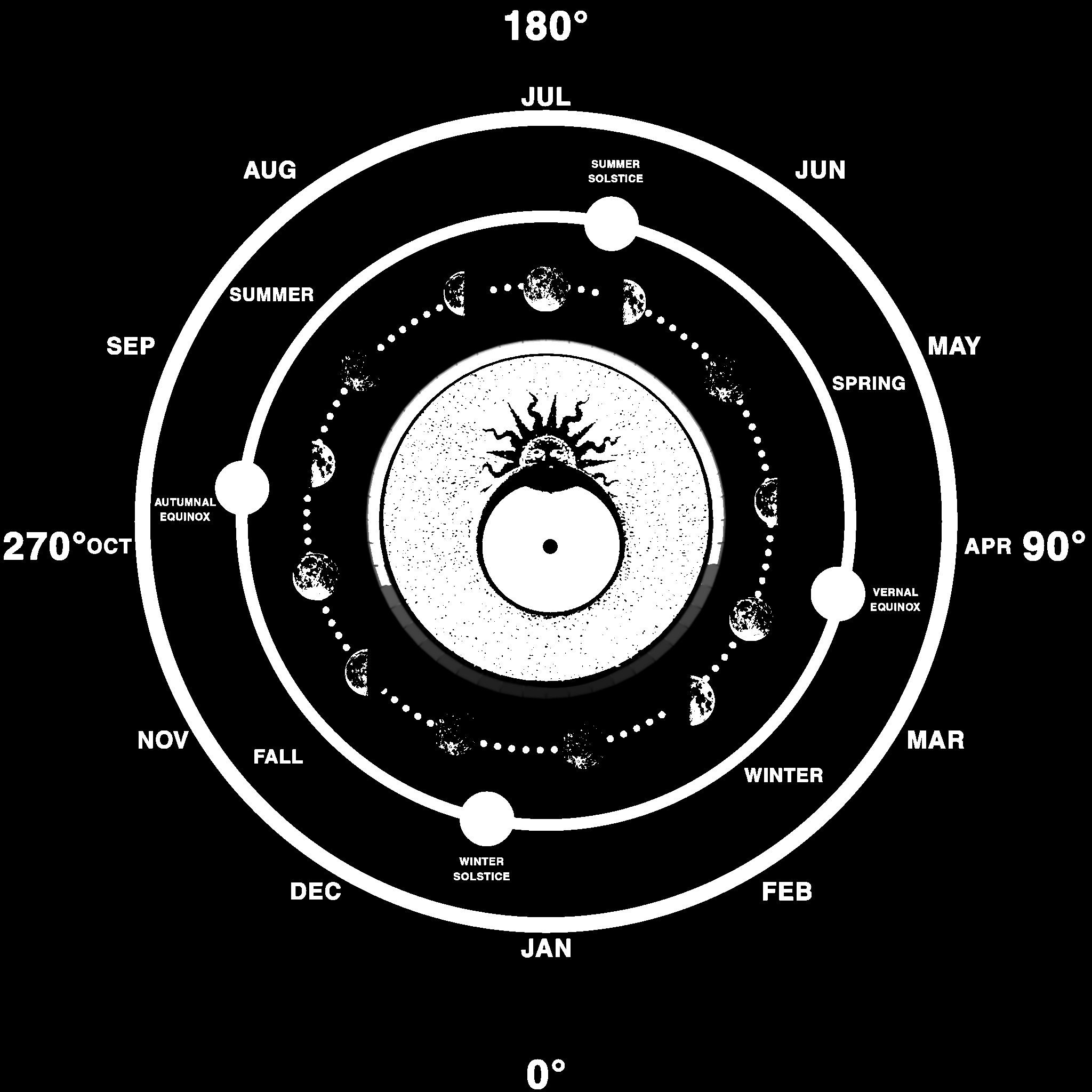
At the Sun’s four columns, the Earth's axial tilt yields to the star's motion at its four extremities. Two solstices at which the day reaches its longest and shortest. Two equinoxes, at which day and night stand equal. The equinoxes and solstices are the cardinal points of the figure.
The figure is sufficient because the geometry is real: the solstices and equinoxes are astronomical events, not ceremonial choices; the cross-quarter midpoints are their mathematical bisections; the twelve Divisiones are the closest equal partition of the circle that maps onto the natural pulse of month-scale duration; the three Aetates are the ordering the four Cardinales themselves prescribe (89 days · 183 days · 89 days). The figure is thus not proposed but found, and the finding is the disclosure.
The object that is called called zodiac by the common tongue describes a late calcification of this figure into twelve animal-human faces; what is called zodiac here describes the manifold circuit of time itself, prior to any face, in the severity of its pure division.
PART II. EPOCH ZERO · TERMINUS A QUO
17. Zero precedes numerical succession; designating a space between tonalities. Zero is the open magnitude from which the sequence and to which it returns. The scale ascends through seven distinct degrees, and the eighth arrives as resolution. The octave logic governs every cycle in this system. The year, week, or day begins at zero and resolves at its eighth, final position, back to zero. The year that closes at the Winter Solstice arrives at the pitch from which it departed, one register higher. Nothing is lost in the return.18. The earliest limit from which the new reckoning can be originated shall be called Epoch Zero; it is designated as the Winter Solstice immediately following Critical Notion's legal incorporation. The period between incorporation and this first Cardinalis Solstitii Inferioris is designated TERMINUS A QUO: the uncounted origin before the reckoning. It is not numbered. Pre-calendar time exists outside Anno Novae. It is the interval before the reckoning begins, and it carries no canonical standing of its own.19. This determination is precise: the institution earns its origin from an external, cosmic event, not from its own self-declaration. The arc of Longitudinal Discipline begins when nature can be called as witness, not when an institution claims it has begun. The Winter Solstice is an astronomical event verifiable by any observer with access to a clear sky or a standard ephemeris. The institution cannot manipulate it. It cannot be declared earlier or later by internal consensus. It falls when it falls.20. From Epoch Zero, time is counted in ANNO NOVAE, "year of new reckoning," designated by Roman numeral: A.N. I, A.N. II, A.N. III, and so on. A.N. I commenced at the first Winter Solstice after incorporation. Each subsequent A.N. commences at the Winter Solstice. The civil calendar date of Epoch Zero shall be recorded in the Order's foundational archive and referenced in all subsequent constitutional documents.━━━━━━━━━━━━━━━━━━━━━━━━━━━━━━━━━━━━━━━━━━━━━━━━━━━━━━━━━━━━━━━━━━
PART III. THE LONG ARC
§ 3.1. ANNO NOVAE
20. A complete solar orbit defines one calendar year, Anno Novae: from Winter Solstice to the next Winter Solstice, a duration of approximately 365.25 days. The A.N. is the fundamental unit of institutional time. All canonical documents carry their A.N. designation as the primary temporal reference. No document dated only by civil calendar date carries full canonical standing.§ 3.2. THE SATURN CONSTANT · CONSTANTIA SATURNI
21. Saturn's orbital period of approximately 29.5 years constitutes the primary generational unit: the minimum evaluation horizon for any major institutional initiative. This designation is precise, not decorative. Saturn governs, in the Order's planetary register, the domain of constitutional governance, structural discipline, and the long formation of institutions. Its orbital period approximates the human generational span. An institution that evaluates its initiatives on quarterly or even annual timescales confuses the operational tempo of its activities with the institutional tempo of its existence.22. What is built in one Saturn cycle is evaluated at the next. The first Constitutional Review: a formal, scheduled reckoning by the Doctrinal Synod with the coherence and trajectory of the Long Experiment: falls at approximately A.N. XXX. It is mandated by this Encyclical and by the Order's Charter. Its agenda shall include the full evaluation of every major institutional initiative undertaken since A.N. I, with particular attention to whether those initiatives have been adequate to the temporal architecture of the Computatio Novae or whether they have, in practice, operated on civil calendar time.§ 3.3. FORMAl OBLIGATION of the LONG ARC
23. Members shall understand and apply the distinction between operational time: the civil calendar, used for logistics and external coordination: and institutional time: the Computatio Novae, governing all canonical acts. This distinction is not metaphor. It is a mandatory cognitive discipline of membership. A member who cannot state the current A.N., Aetas, and nearest Cardinalis without reference to a civil date has not yet integrated the foundational layer of formation. That integration is required.━━━━━━━━━━━━━━━━━━━━━━━━━━━━━━━━━━━━━━━━━━━━━━━━━━━━━━━━━━━━━━━━━━
PART IV. THE MESOSCALE
§ 4.1. THE CARDINALES: FOUR INSTITUTIONAL OBLIGATIONS
24. From the Earth’s static vantage, the Sun makes an annual pilgrimage across four quadrants in the sky. The four arcs, the solstices and equinoxes, the moments at which the Sun reaches its maximum distance from the celestial equator or crosses it, divide the solar year at four critical junctures that shall be called CARDINALES. At the winter solstice, the Sun reaches its lowest declination above the horizon and the day its shortest duration. The Sun passes through total equilibrium at the vernal and autumnal equinoxes: twelve hours of light, twelve of dark, a balance that holds for a day and then resolves in one direction or the other. At the summer solstice, the arc completes its inversion. These are verifiable phenomena, intelligible to any observer with a clear horizon. 25. Carrying the full weight of the Sun's apparent motion, the year physically bends at its four coordinates. Their temporal orientation is calculable to the second for any year, past or future. The Gregorian calendar places these events in the third week of their respective months, a placement that makes them secondary to administrative convention. The year is heavier in some places than it is in others as a mechanical consequence of Earth's elliptical orbit. Intervals between Cardinales are unequal: 89 days from winter solstice to vernal equinox, 93 from vernal to summer, 94 from summer to autumnal, 89 from autumnal to winter. To measure the year in this uneven vocabulary of solar migration as a constant that repeats is to feel that weight at the points where it distributes; to know the year's actual structure, not the Gregorian fiction imposed over it. 26. The Cardinales have governed institutional life since the first human beings found it necessary to know the time of year they inhabited. As such, each Cardinalis possesses a specific institutional gravity that the physical fact alone does not contain. The four solar cardinal points shall constitute the institution’s primary scheduling thresholds. All major institutional acts: Encyclical promulgation, Cell chartering, initiation rites, grade advancements, archival sealing, are mandated to coincide with a Cardinalis or a designated Ortus Heliacalis. Precise civil dates for each Cardinalis shall be verified annually through a standard astronomical source. The Liturgical Committee publishes these dates in the Ephemeris Annualis at the opening of each A.N.A year divided by three non-equidistant portions has legitimate historical precedent in the three-part structure of agricultural time. There is a period for cultivation, which is intentional and demanding. What follows is a period of growth, whose yield is enhanced by cultivation. The period that acquires what flourished from its labor, fulfills the act of cultivation; the ongoing process continues into the next cycle.
C.I · Cardinalis Solstitii Inferioris · Winter Solstice. The new year commences at the WINTER SOLSTICE, the Cardinalis Solstitii Inferioris, the moment in which the Sun completes its descent to its lowest altitude in the Northern Hemisphere. At the point of minimum declination, the Sun withdraws its presence. Darkness reaches its depth at maximum hiddenness and minimum solar expression, just before the return. It inaugurates the season oriented towards the inward labor. As such, AETAS STATUTORUM opens at this juncture. This first observable point of the new year is designated C.I. It is the appropriate moment to nurture what must come before anything else can proceed. at the point of maximum solar declination in the Northern Hemisphere, when darkness reaches its depth beneath the horizon before the Sun's long return. The year’s first observable point is designated C.I. The Sun hides below the equator; its minimal altitude is global. It is the appropriate moment for the promulgation of encyclical literature; constitutional acts; opening the Major Synod; issuing the Ephemeris Annualis shall be published at this juncture; the things that must be stated before anything else can proceed. It is oriented toward the inward labor, the descent into philosophical foundations or categorical statutes. Thus, Aetas Statutorum opens at this threshold.C.II · Cardinalis Aequinoctii Vernalis · Vernal Equinox. At the first moment of equipoise, when day and night hold equal measure, begins the period of outward labor. It is the time of new beginnings and new formations. It is the point at which the paideia cycle begins, and oriented toward the emergence into outward engagement. It is thus the appropriate moment to charter a new cohort. Aetas Emanationum opens at this threshold.
C.III · Cardinalis Solstitii Superioris · Summer Solstice. At maximum solar ascent, when daylight reaches its furthest extension across the Northern hemisphere,
Fullest extension of daylight in the Northern Hemisphere; astronomical maximum
solar altitude applies globally. Designated for: Public Seminars; AGORA launches;
peak somatic protocol cycles; external institutional acts. Formation orientation:
the body and the world at maximum engagement; the midpoint of Aetas Emanationum.
C.IV · Cardinalis Aequinoctii Autumnalis · Autumnal Equinox. Second equipoise.
Day surrendering to night. Designated for: grade advancements; archival sealing;
Synod reviews; cooperative surplus distribution; opening of formation assessment
period. Formation orientation: the knower drawing inward; the Aetas Praeceptorum
opens at this threshold.
§ 4.2. THE AETATES: THREE LABORs of FORMATION & DOCTRINe
30. The model of four seasons was an artefact of social convention. Varying by latitude with no fixed astronomical basis, it imposed equal duration on periods that are physically unequal. A year divided by three non-equidistant portions has legitimate historical precedent in the three-part structure of agricultural time. The solar year, in its own terms, has three functional arcs. There is a period of cultivation, which is intentional and demanding. What follows is a period of growth, whose yield is enhanced by cultivation. The final period, that which acquires what flourishes from its labor, fulfills the act of cultivation; the ongoing process continues into the next cycle. 31. Three sustained periods of qualitative orientation, AETATES, correspond to the Categories, a tripartite structure in which the environment, the mind, and the metaphysical interact to define reality. STATUTES are in itself and transcendent. As such, they are not limited by space and temporality, but foundational. The Statutes are the categorical species of ontology. EMANATIONS are in nature and made to be known. As such, they are bound to space and temporality, within the universe’s domain as it presents itself to observation and practice. The Emanations are the categorical species of natural science. PRECEPTS are in the knower and transcendental to what it can know. As such, they are incommensurable portions of space and temporality through which the intellect is situated, and it is within this taxonomy that its vague ideas of here, now, is, adapts. The Precepts are the categorical species of understanding. 32. The three Categories are simultaneous, non-sequential orientations. The individual inhabits all three at every moment. The Aetates carry doctrinal tendencies that are not incidental to their astronomical character but derived from it. The Cardinales determine their focus, inscribing their asymmetry without correction. Contrary to the four-season paradigm, the Aetates do not assign separate registers to different periods of the year; they emphasize which register is primary, which Category warrants intensive engagement in each period of the annual cycle. The Aetates are not merely descriptive; they mandate formation. The Paideia shall sequence all curriculum modules to align with the Aetas in which they are delivered. The Liturgical Committee shall specify, in each Ephemeris Annualis, the doctrinal emphases and practice orientations for each Aetas of the current A.N.33. AETAS STATUTORUM · C.I to C.II · Approximately 91 Days. The Season of Statutes extends from Winter Solstice through the deepest months to the first median of the Vernal Equinox. It is the Aetas of maximum demand and minimum distraction. Its short arc is pure and bare, but also fertile. As such, it is a brief, dark period oriented inward with nothing to observe at dawn; of discipline that cannot be done in the light. Its duration has no fixed, rising star, yet it establishes the foundations of what the year's work will become. It is the natural time to perform the concentrated, psychic labor that shorter days and longer nights actually support. It shall be institutionally acknowledged by the mandate of intensive study; doctrinal literature; philosophical formation modules; interior protocols. What cannot receed inward to concentrated focus during this period will not be brought to it at all during the current A.N.TKThe Season of Statutes extends from the winter solstice through the deepest months to the first median of the vernal equinox, when the Sun is still ascending from its minimum, and the arc of light is still short.
AETAS EMANATIONUM · C.II to C.IV · Approximately 183 Days. The Season of Emanations extends from the Vernal Equinox through Summer Solstice into the Autumnal Equinox. It is the active period of embodied practice, of a world encountered directly rather than contemplated. It is the generative Aetas; as such, it exists in a living, corporeal, scientific register. It shall be institutionally acknowledged by the practical mandate of somatic protocols; field cycles; corprosyndical engagement; the AE Protocol; and public-facing institutional activity.
Its duration spans two inter-Cardinal arcs, containing three fixed stars in rising, because worldly engagement, honestly undertaken, cannot be compressed. Nature at full operation demands commensurate, material interaction with it from all. The longest season is the one that demands the most.
AETAS PRAECEPTORUM · C.IV to C.I · Approximately 91 Days. The Season of Precepts extends from Autumnal Equinox to Winter Solstice. It is the Aetas of epistemic consolidation; the stage at which the knower digests what the year has provided. It is the necessary reflection that must precede the next descent. It is acknowledged only through the practices of written synthesis of the year’s work; archival completion; preparation for the new year; assessment and potential advancement. It is the period in which what has been encountered becomes integrated.
§ 4.3. THE FIVE ORTUS HELIACALES: OBSERVATIONAL OBLIGATIONS
The Ortus Heliacales are observational events: The fixed-star heliacal risings shall constitute subelements interfacing between Aetates. Members are obligated to observe each heavenly body in rising before dawn on the designated morning and locate the star at the eastern horizon. The observation is the act. No elaboration beyond direct observation is mandated or permitted as a substitute for it. The Ephemeris Annualis publishes precise dates for each Ortus, calibrated for the latitude bands of the Order's Archipelago. Members shall use the dates corresponding to their latitude of residence; see §10 for the full Latitude Calibration Protocol.The ORTUS HELIACALES, nine fixed stars, rising above the eastern horizon in the sky before the Sun, shall constitute the sub-elements interfacing between seasons. Members are
ORTUS FOMALHAUTIS (~March 15). ORTUS FOMLHAUTIS arrives in the final days of the bare arc. It is the year’s first stellar event, which communicates to the observer that the dark, inward labor is ending.
Fomalhaut is a low-altitude star at northern latitudes — difficult to observe, requiring a clear southern horizon and patience. Its practical signal is simple: the dark inward arc is ending. Whatever work was suited to the winter's interior quality is in its last days. The approach of C.II is five days away. Fomalhautis is the advance announcement of the long arc, not a celebration of it.
ORTUS ALDEBARI · Aldebaran (alpha Tauri) · Approximately Late June at 40 Degrees North. Aetas Emanationum. Function: threshold before C.III; preparation for peak somatic and public-facing engagement.
ORTUS SIRII · Sirius (alpha Canis Majoris) · Approximately Mid-August at 40
Degrees North. Aetas Emanationum. Function: promulgation of strategic Encyclicals;
institutional intensification. The brightest fixed star visible from the Order's
primary latitudes, reserved for the Order's most consequential external communications. The Doctrinal Synod may designate additional acts to coincide
with this rising in any given A.N. The latitude variation for Sirius is the
largest in the system: approximately 59 days between 40 degrees North and 35
degrees South. The Ephemeris Annualis shall publish zone-specific dates.
ORTUS REGULI · Regulus (alpha Leonis) · approximately early September across all
latitude bands. Aetas Emanationum. Function: peak of Aetas Emanationum; height
of outward work and somatic intensification.
ORTUS SPICAE · Spica (alpha Virginis) · approximately late October to early
November. Aetas Praeceptorum. Function: harvest marker; grade advancement review
opens; archival preparation commences.
ORTUS ANTAREDIS · Antares (alpha Scorpii) · approximately mid-to-late December. Aetas Praeceptorum. Function: final descent before C.I; year's archive sealed; preparation of Annual Reckoning. The observation marks the year's approach to its Threshold.
━━━━━━━━━━━━━━━━━━━━━━━━━━━━━━━━━━━━━━━━━━━━━━━━━━━━━━━━━━━━━━━━━━
PART V. THE ACUTE SUBLUNARY
The lunar cycle governs the rhythm of individual or local practice. The Moon's Pillar dwells in the spatial octave of dimensionality. It is the tree of life governing the member's ascending movement through formation, while the Sun's pillar governs the institution's collective temporal descent. These two movements operate simultaneously and do not conflict. The solar cycle is the collective's descent into greater coherence; the lunar cycle is the individual's ascent through gradual formation. Both are necessary. Neither is optional.TK
TK
TK
TK
TK
TK
PART VI. THE LONGITUDINES PLANETARUM
TK
TK
TK
TK
TK
TK
TK
TK
PLUTO · ♇ · Orbital Period of Approximately 248 years. Pluto completes one cycle per two-and-a-half centuries, a scale that impresses onto the rhythm of civilizational formation. Pluto measures the outermost scale at which the undimensioned point and instant reappear as primitive notions of a non-human space-time indifferent to civil life. Its time eclipses living memory for most organizations; empires are born and perish in the span of a Plutonian year. That is to say, Pluto represents the horizon at which institutions dissolve and become part of history. Doctrinally, it shall serve the function of marking historical dissolution and regeneration. At the operational level, its time shall be reserved for charter clauses governing institutional transformation. A document invoking Plutonian time is epoch-making in designation; its promulgation requires the assent of the Honorary Directorate.TK
TK
PRÆSCRIPTA · APPENDIX AD CALENDARIUM NŒSOPHICUM · PRACTICAL USES CONCERNING LIVING & STRUCTURE
CANON I. RATIONAE SYNOPTICA · ON THE SYNOPTIC PRINCIPLE OF THE MANIFOLD YEAR
On the Synoptic
TK
This appendix ratifies, as standing canon, two instruments: the inscription of date and the graded notation system.
The year is governed by apparent movement of the Sun. The motion of the Sun’s rising and falling, from east to west, governs the diurnal time of Man. Man is under the cyclical time of the Moon.
CANON DE MENSURA NON-HUMANA · The Principle of Non-Humanist Orientation
The exomodern calendar is
CANON EPOCHĒ NULLA · TERMINUS A QUO · LAW OF OCTAVES
The new chronographic science is one law at its most primitive applied at all scales of temporal geometry. Zero designates a space between tonalities which precedes the succession of positive integers. The scale ascends through seven distinct degrees, and the eighth arrives as resolution. Zero is the open magnitude from which the sequence begins. Zero is the terminus to which it all returns. The octave logic governs every cycle in this system. The year, week, or day begins at zero and resolves at its eighth, final position, back to zero. Each scale recapitulates the octave’s nested figure. The year that closes at the Winter Solstice arrives at the pitch from which it departed, one register higher. Nothing is lost in the return.
18. The earliest limit from which the new reckoning can be originated shall be called Epoch Zero; it is designated as the Winter Solstice immediately following Critical Notion's legal incorporation. The period between incorporation and this first Cardinalis Solstitii Inferioris is designated TERMINUS A QUO: the uncounted origin before the reckoning. It is not numbered. Pre-calendar time exists outside Anno Novae. It is the interval before the reckoning begins, and it carries no canonical standing of its own.19. This determination is precise: the institution earns its origin from an external, cosmic event, not from its own self-declaration. The arc of Longitudinal Discipline begins when nature can be called as witness, not when an institution claims it has begun. The Winter Solstice is an astronomical event verifiable by any observer with access to a clear sky or a standard ephemeris. The institution cannot manipulate it. It cannot be declared earlier or later by internal consensus. It falls when it falls.CANON ANNUS NOVUS SIDERUM INCIPIT · DE REVOLUTIONIBUS CIRCUITUS ZODIACI · THE SOLAR RECURRENCE. From Epoch Zero, the exomodern year shall be dated ANNO NOVO SIDERUM, “in the new year of the stars,” and numbered in Roman order: A.N. I, A.N. II, A.N. III, unto succession. A.N. I commenced upon the first Winter Solstice following incorporation. One complete solar revolution constitutes a zodiacal year, extending from one Winter Solstice to the next, a duration of approximately 365.25 days. The A.N. is the fundamental coordinate of institutional time. Every canonical document shall bear its A.N. designation as its primary temporal reference; no document dated solely according to the civil calendar shall possess full canonical standing.Each successive A.N. commences at the Winter Solstice. The civil-calendar date of Epoch Zero shall be entered into the foundational archive of the Order and cited in all subsequent constitutional instruments.CANON PROCESSIONIS ANNI ZODIACALIS PER PARTES EIUS · THE ZODIACAL YEAR THROUGH TWELVE DIVISIONSThe year is circle of living forms. The Body and Soul are formed under DIVISIONES, the curved procession of the zodiac in twelve parts. The twelve partitions of the zodiac inhabit the severity of the formative rule of life. Each Divisio carries its native interior orientation, Disciplina, and a specific operative labor, Activitas. DIVISIO I · Hiems prima · 0°–29°59′. DIVISIO II · Hiems media · 30°–59°59′DIVISIO III · Hiems ultima · 60°–89°59′DIVISIO IV ·Ver primum · 90°–119°59′DIVISIO V · Ver medium · 120°–149°59′DIVISIO VI · Ver ultimum · 150°–179°59′DIVISIO VII · Aestas prima · 180°–209°59′DIVISIO VIII · Aestas media · 210°–239°59′DIVISIO IX · Aestas ultima · 240°–269°59′DIVISIO X · Autumnus primus · 270°–299°59′DIVISIO XI · Autumnus medius · 300°–329°59′DIVISIO XII · Autumnus ultimus · 330°–359°59′CANON CRUCES ·
TJ
CRUX HIEMIS–VERIS
CRUX VERIS–AESTATIS
CRUX AESTATIS–AUTUMNI
CRUX AUTUMNI–HIEMIS
CANON CARDINALES · THE FOUR SOLAR COLUMNS at which the Sun reaches its maximum distance from the celestial equator or crosses it, divide the solar year at four critical junctures that shall be called CARDINALES. At the winter solstice, the Sun reaches its lowest declination above the horizon and the day its shortest duration. The Sun passes through total equilibrium at the vernal and autumnal equinoxes: twelve hours of light, twelve of dark, a balance that holds for a day and then resolves in one direction or the other. At the summer solstice, the arc completes its inversion. These are verifiable phenomena, intelligible to any observer with a clear horizon.
2. Carrying the full weight of the Sun's apparent motion, the year physically bends at its four coordinates. Their temporal orientation is calculable to the second for any year, past or future. The Gregorian calendar places these events in the third week of their respective months, a placement that makes them secondary to administrative convention. The year is heavier in some places than it is in others as a mechanical consequence of Earth's elliptical orbit. Intervals between Cardinales are unequal: 89 days from winter solstice to vernal equinox, 93 from vernal to summer, 94 from summer to autumnal, 89 from autumnal to winter. To measure the year in this uneven vocabulary of solar migration as a constant that repeats is to feel that weight at the points where it distributes; to know the year's actual structure, not the Gregorian fiction imposed over it.
3. The Cardinales have governed institutional life since Man found it necessary to know the time of year the human inhabited. Cardinales individually possess a formal gravity that the physical fact alone does not contain. The four solar cardinal points shall constitute the institution’s primary scheduling thresholds. All major institutional acts: Encyclical promulgation, Cell chartering, initiation rites, grade advancements, archival sealing, are mandated to coincide with a Cardinalis or a designated Ortus Heliacalis. Precise civil dates for each Cardinalis shall be verified annually through a standard astronomical source. The Liturgical Committee publishes these dates in the Ephemeris Annualis at the opening of each A.N.
C.I · Cardinalis Solstitii Inferioris · Winter Solstice. Approximate date: 21 December.
C.II · Cardinalis Aequinoctii Vernalis · Vernal Equinox. Approximate date: 20 March.
C.III · Cardinalis Solstitii Superioris · Summer Solstice. Approximate date: 21 June.
C.IV · Cardinalis Aequinoctii Autumnalis · Autumnal Equinox. Approximate date: 22/23 September.
CANON AETATES TRIPARTITAE · TRES ARCUS CŒTICI · THE SEASONAL LABORS OF DOCTRINE & FORMATION occur at three intervals
Beneath heaven’s geodesic vault, in accordance with their ordained position relative to the Earth, the Cardinales yield three arcs: from winter solstice unto vernal equinox, from vernal equinox unto the fall equinox, from the fall equinox unto the repeating winter solstice. The annual circuit is apportioned into three unequal intervals. The first is given to foundation, which is intentional and demanding. What follows is a period of growth, whose yield is enhanced by cultivation. The period that acquires what flourished from its labor, fulfills the act of cultivation; the ongoing process continues into the next cycle.
5. Three sustained periods of qualitative orientation, AETATES, correspond to the Categories, a tripartite structure in which the environment, the mind, and the metaphysical interact to define reality. STATUTES are independent and unbound by time and space. The Statutes are the categorical species of ontology. EMANATIONS are in nature and made to be known. As such, they are bound to space and temporality, within the universe’s domain as it presents itself to observation and practice. The Emanations are the categorical species of natural science. PRECEPTS are in the knower and transcendental to what it can know. They are incommensurable portions of space and temporality through which the intellect is situated, and it is within this taxonomy that its vague ideas of here, now, is, adapts. The Precepts are the categorical species of understanding.
6. The Categories are simultaneous, non-sequential orientations. The individual inhabits all three at every moment. The Aetates carry doctrinal tendencies that are not incidental to their astronomical character but derived from it. The Cardinales determine their focus, inscribing their asymmetry without correction. Contrary to the four-season paradigm, the Aetates do not assign separate registers to different periods of the year; they emphasize which register is primary, which Category warrants intensive engagement in each period of the annual cycle. The Aetates are not merely descriptive; they mandate formation. The Paideia shall sequence all curriculum modules to align with the Aetas in which they are delivered. The Liturgical Committee shall specify, in each Ephemeris Annualis, the doctrinal emphases and practice orientations for each Aetas of the current A.N.
7. AETAS STATUTORUM · C.I to C.II · Approximately 91 Days. The Season of Statutes extends from Winter Solstice through the deepest months to the first median of the Vernal Equinox. It is the Aetas of maximum demand and minimum distraction. Its short arc is pure and bare, but also fertile. As such, it is a brief, dark period oriented inward with nothing to observe at dawn; of discipline that cannot be done in the light. Its duration has no fixed, rising star, yet it establishes the foundations of what the year's work will become. It is the natural time to perform the concentrated, psychic labor that shorter days and longer nights actually support. It shall be institutionally acknowledged by the mandate of intensive study; doctrinal literature; philosophical formation modules; interior protocols. What cannot recede inward to concentrated focus during this period will not be brought to it at all during the current A.N.
AETAS EMANATIONUM · C.II. to C.IV. · Approximately 183 Days.
AETAS PRAECEPTORUM · C.IV. to C.I. · Approximately 89 Days.
TK
TK
TK
TK
CANON ORTUS HELICALES
The seven fixed stars are immanent witnesses looking back at the Earth, at the drama of human ritual repeating through millennia, with or without recognition from Man.
The seven are measured in the sequence that the Earth’s revolution carries each star out of a period of obscurity behind the Sun’s glare, becoming visible again on the eastern horizon just before sunrise. The witnesses take the chronographic science into regions outside the common jurisdiction of solar system or Earth. The star calls the practitioner to the horizon to witness them gazing upon Man and history from the remote. Their appearance sanctifies the day, thus the act staring back at them in recognition is rite.
The consecrated acts witnessing, appearance, observation, and recognition,
the act of staring back at them is the rite. Their appearance sanctifies the day, fastening the year’s curved features to the architecture of the celestial sphere itself. The activities of observation
ORTUS FORMALHAUTIS · α Piscis Austrini · ~15 Mar · Aetas Statutorum (cl.)
TK
TK
TK CANON LUNATIO · LUNA VITAM IN QUATTUOR PHASIBUS REGIT · THE SYNODIC MONTH
The Moon returns to the same angular relationship with the Sun every 29.5 days.
TK
TK
NOVILUNIUM
QUADRANS CRESCENS
PLENILUNIUM. The full Moon is globally simultaneous
QUADRANS DECRESCENS
TK
TK
TK
CANON HEBDOMADA OCTAVAE ·Eight-day named cycle. Derived from the eight Temporal Precepts of the Dimensional Schema. Day 0 through Day 7; Day 8 is Day 0 of the next cycle. The octave: nine positions, eight intervals, the ninth arriving home.J.T. Fraser identified a hierarchy of temporal orders corresponding to different levels of physical and biological complexity. Each is not merely a scale of time but a distinct mode of temporal experience — an umwelt, a surrounding world organized by that level's particular relationship to past and future. The eight Precepts of the Dimensional Schema correspond to these levels. Each day of the Octava names one mode of inhabiting time.Day 0 · OCCURRENTIA · Atemporal. A photon does not age. Released from a stellar core, it travels across eight light-minutes that are, for it, no duration whatsoever. The atemporal is not emptiness — it is the condition prior to the question of temporal direction. Before sequence: before before and after. OCCURRENTIA names the day that belongs to neither the cycle that ended nor the one that begins.Day 1 · CIRCUMSTANTIA · Prototemporal. The particle exists in a field of conditions — charge, proximity, quantum state — that constrain without determining from the inside. Events occur without following one another in any fixed order; "before" and "after" are statistical tendencies rather than rails. Time as situation: what surrounds and contains the event shapes it more decisively than any prior cause.Day 2 · CONCURRENTIA · Eotemporal. The great physical processes run simultaneously across the cosmos. Entropy increases everywhere. The arrow of time has direction but no witness; no living system is present to experience a present. Time with direction but without a now: the universe's temporal order before life appeared to inhabit it as an experienced moment.Day 3 · COINCIDENTIA · Biotemporal. A plant turns toward light hours before the sun reaches its peak. A body grows hungry on a schedule it did not choose. The biotemporal is time as organic rhythm: a present emerges for the first time, narrow and insistent, already beginning to feel the next moment. Memory and anticipation appear without self-awareness. The living body inhabits time before it can name the experience.Day 4 · CAUSALITAS · Nootemporal. One thing happened because another preceded it. The causal chain is reconstructed after the fact and projected forward with confidence. This is the nootemporal: time as narrative, as identity continuous across events, as the self that persists by understanding how yesterday connects to tomorrow. The mind that knows it has a history and will have a future is living in nootemporal time.Day 5 · SYNCHRONICITAS · Sociotemporal. A date is not a moment in physics. It is a moment recognized as significant by a community of minds tracking it simultaneously. The anniversary, the coordinated observance, the event that becomes real only because multiple lives are running in parallel and orient to it together: the sociotemporal requires other minds to exist as time at all.Day 6 · SYNERGIA · Sacrotemporal. The vigil is not real after one night. It is real only after it has been maintained across many. Sacrotemporal time is the product of repetition oriented toward something larger than the individual arc. Not transcendence in the mystical sense: commitment, in the technical sense. The practitioner whose time is organized by a direction that exceeds self-reference is living in sacrotemporal time.Day 7 · DINERGIA · Transtemporal. Fraser described the creative horizon as the moment when a new temporal order becomes possible — when the polarities that organized the prior levels resolve into a unity that neither could generate alone. Biological and noetic, personal and social, each present in the other without canceling. DINERGIA is the day of integration before the return: not the end of the cycle but its consummation.Day 8 is equal with Day 0 · OCCURRENTIA. The scale arrives at its origin and the octave is complete.CANON NOVEM STATIONES DIEI · The Nine Observances of the DayThe day is structured according to nine stations, STATIONES DIEI, numbered 0 through 8. The first is called ANTE LUCEM. The last is NOX, which resolves to the next ANTE LUCEM. The Stationes are defined by the Sun's observable position relative to the horizon, not by equal clock-intervals from midnight. Their civil-time equivalents vary by season and latitude. The Ephemeris Annualis shall publishes those equivalents annually.Station 0 · ANTE LUCEM. Pre-dawn. The sky is no longer fully dark but the Sun has not yet appeared. Neither night nor day: the threshold. Any person who has stood outside before dawn knows this quality. The day begins before it begins.Station 1 · AURORA. From below, the sky brightens. The horizon becomes indistinguishable from the sky above it. Color returns, saturating the naked eye. Station 2 · ORTUS SOLIS. The Sun's upper limb crosses the horizon. The day fully opens.Station 3 · MANE. Morning. The Sun ascends the lower quadrant of its arc. The light still carries the quality of early day.Station 4 · MERIDIES. Solar culmination. The Sun at its maximum altitude for the day. This occurs at a different clock-hour in winter and summer. The station is defined by the sky.Station 5 · POST MERIDIEM. Afternoon. The Sun descends through the upper quadrant of its arc. The light begins to warm in color.Station 6 · VESPER. Evening. The Sun approaching the horizon from above.Station 7 · CREPUSCULUM. The Sun has set. Twilight remains. The sky holds color without a source.Station 8 · NOX. Night. The stars become visible as twilight fades. The night resolves to All twilight has faded. The stars are fully visible. This station resolves to ANTE LUCEM of the following day. Every day completes its arc and opens the next threshold.TK
TK
TK
NOTATION
TK
TK
TK
TK
CANON DERP · FORMA DATATIONIS · ON THE FORMAL INSCRIPTION OF DATE
Every institutional document, when dated under the Aevum Ordinis Siderea, shall bear the form:Datum in Divisione VII, Statione Meridie, sub Plenilunio, Aevi Ordinis Sidereae, Anno Novae I.
[body of the synodal act]
[signatures]
A.N. I · C.I / A.St. / O.An. / sub Plenilunio / Statione Meridie / Saturnus 14° Aquarii
— Founders Circle Notation
The three temporal clauses shall correspond with the observer's position at the annual, daily, and monthly scales. The optional proxima Ortu clause is invoked when a heliacal rising falls within three days of the inscription. The genitive Aevi Ordinis Sidereae names the calendar's era. Anno Novae [N] counts the year from the calendar's inauguration.The form is to be used in all foundational documents, in inscriptions of canon, in the dating of the Diary folios, and in all correspondence the Order chooses to mark as formally issued.CANON · NOTATIO PER GRADUS · GRADED NOTATIONAll official documents shall employ the following notation system. The document's access classification shall identify the tier of detail. Members shall be able to read and produce notation at all tiers up to and including the Canonical tier. Honorary Directorate notation requires planetary longitude obtained from a standard ephemeris.
PUBLIC · EXTERNAL CIRCULATION. Form: A.N. – Cardinalis in plain language.
Example: A.N. I – Winter Solstice.
GENERAL CIRCULATION ENCYCLIA. Form: A.N. + Cardinalis in Latin abbreviation.
Example: A.N. I – C.I, Cardinalis Solstitii Inferioris.
INTERNAL · FORMATION DOCUMENTS. Form: A.N. + Cardinalis + Aetas.
Example: A.N. I – C.I / Aetas Statutorum.
CANONICAL · LITURGICAL TEXTS. It shall take the following form: A.N. + Cardinalis + Aetas + Ortus.
Example: A.N. I – C.I / Æ.St. / Ortus Antaredis.
SECTION 4.1.2 ABBREVIATION TABLE
A.N., Anno Novae (year of the Nova)
C.I, Cardinalis Solstitii Inferioris (Winter Solstice)
C.II, Cardinalis Aequinoctii Vernalis (Vernal Equinox)
C.III, Cardinalis Solstitii Superioris (Summer Solstice)
C.IV, Cardinalis Aequinoctii Autumnalis (Autumnal Equinox)
Æ.St., Aetas Statutorum
Æ.Em., Aetas Emanationum
Æ.Pr., Aetas Praeceptorum
O.Al., Ortus Aldebari
O.Si., Ortus Sirii
O.Re., Ortus Reguli
O.Sp., Ortus Spicae
O.An., Ortus Antaredis
TKDatum in Divisione VII,
Statione Meridie,
sub Plenilunio,
proxima Ortu Siri,
Aevi Ordinis Sidereae,
Anno Novae I.
ANATHEMA ·
TK
COLOPHON
Datum in Divisione VII, Statione Meridie, sub Plenilunio, Aevi Ordinis Sidereae, Anno Novae I.
SŒC
[signatures]
A.N. I – C.I · Æ.St. · O.An. · sub Plenilunio · Statione Meridie · Saturnus 14° Aquarii
— Founders Circle Notation
