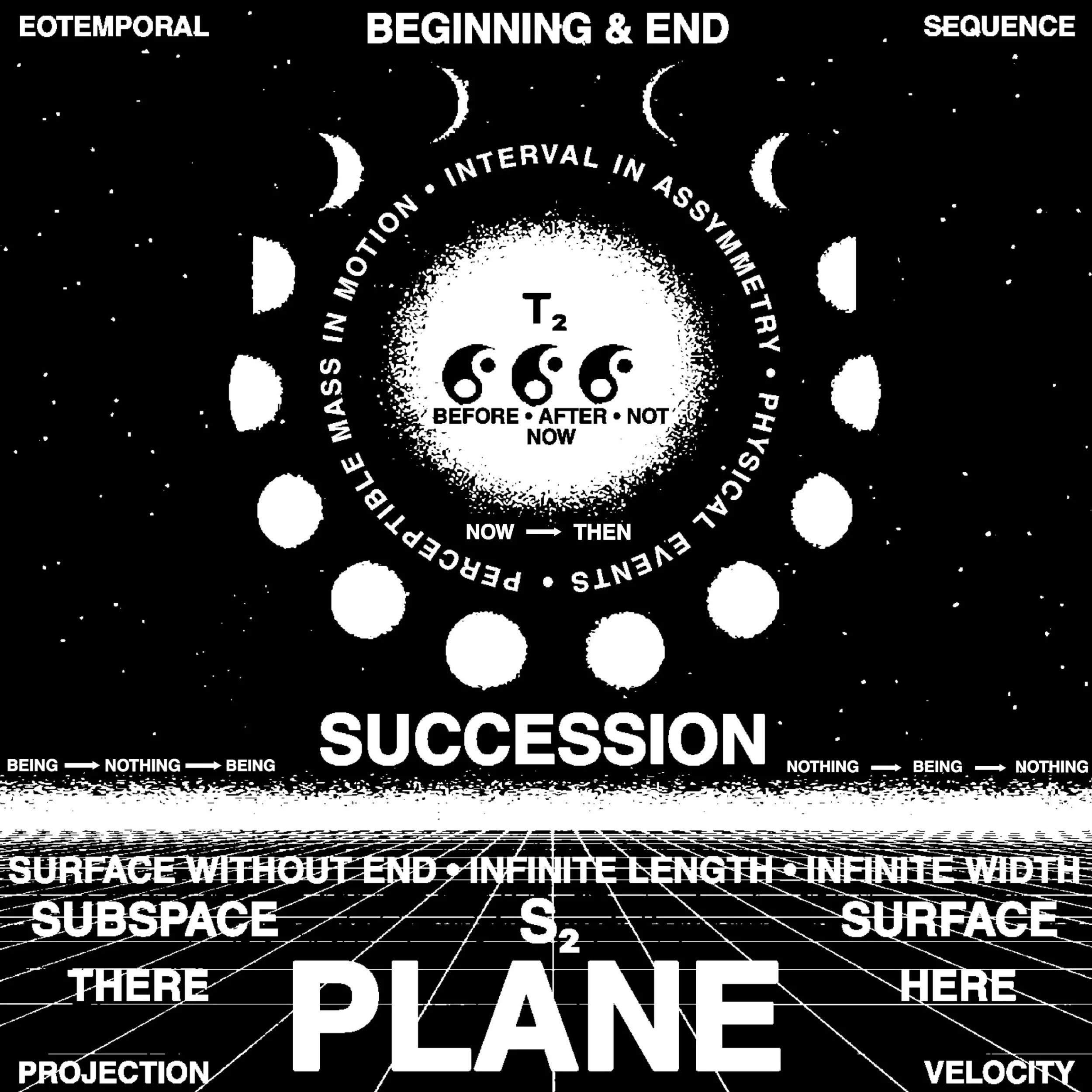
UNIVERSAL UNCONSCIOUS: PROLEGOMENA TO REFLECTIONS ON CREATION & SPACE
The fulcrum by which reality turns is called necessity.
Necessity limits reality. Necessity is the non-negotiable force, dimembering the Absolute in relative st.
ReasonReason gives reality purpose.
The patterns of growth describe the interaction between Necessity and Reason.
Form, Substance, Will are subordinate to Necesstiy and Reason.
/==
In all things everywhere exists a chain of expansion and contractions in effects and their causes, of pure thought which enters being or pure relinquishment which negates thinking but enables its dimensionality.
Contraction is a germinal nexus of functions holding the elements together. It preserves and creates whatever is held by preservation. It is the transcendental condition of and toward causation. Existing would be empty, inconceivable space were it to cease.
Expansion negates the center. It is the tangential pattern from cause to effect, without which existing would be a point needing breadth. Expansion separates these functions into visible orders of magnitude increasing in mass and distance.
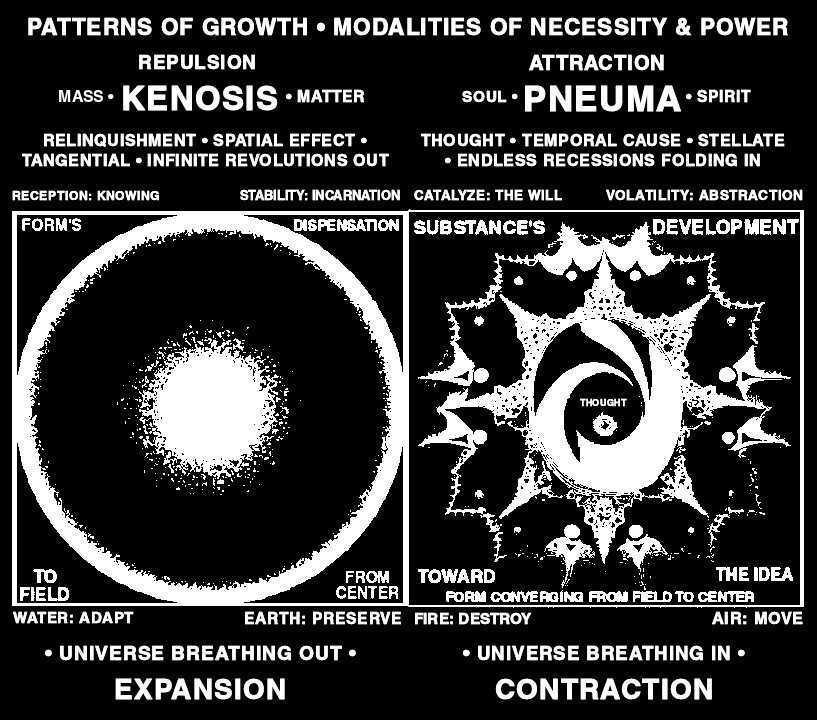
Contraction's self-affirming modality is called thought. Thought is the universe breathing inward—endless recession to a center. Its activity of concealment from peripheral non-being toward a critical notion draws everything to accretion producing interiority.
The modality of Expansion is called relinquishment. Relinquishment is the universe breathing outward in ceaseless revolutions from an origin.
Contraction and Expansion develop in gradual proportion—they are equally infinite but infinitely opposed and inharmonious. The patterns of growth emphasize and repeat in one another everywhere—the trauma of temporality, creation, and space resound from this exchange.
The nexus of Function is Form which follows from it. Their degree of separation is called Field. The phenomena of Substance is the irreducible remainder. Capitulating in one another, Relinquishment and Thought refine themselves at scale.
Contraction manipulates particle and wave. Expansion extends particulate matter to distances unreachable by Man.
[Relinquishment comforts the intellect, relaxes the Body, and promotes introspection.
[Thought animates the Body, stimulates the intellect, and promotes outward attention.
===
Form
Form exists at the intuition's periphery, outside the margins of tactile sensation. Form shapes the object that partakes in it, thus making it concrete–thus making it intelligible. Form perfects the unformed substance.
Without a corresponding Substance, Form is unknowable. Substance is indistinguishable without Form.
Substance bestows the property of immanence upon the object. The empirically infinite statute has no emanation–as such, it is self-external causation.
Substance does submit to the categories of Form, it is neither temporally nor spatially determined. At no particular instant does immanence first emerge nor will it end at any singular point. Rather it manifests at every instance and extends into all points, in all spaces, vast or minor. Substance is the empirically infinite statute—a self-external causation, the Abslute
[Creation is goverended by the influence of Substance, Force, and Energy.
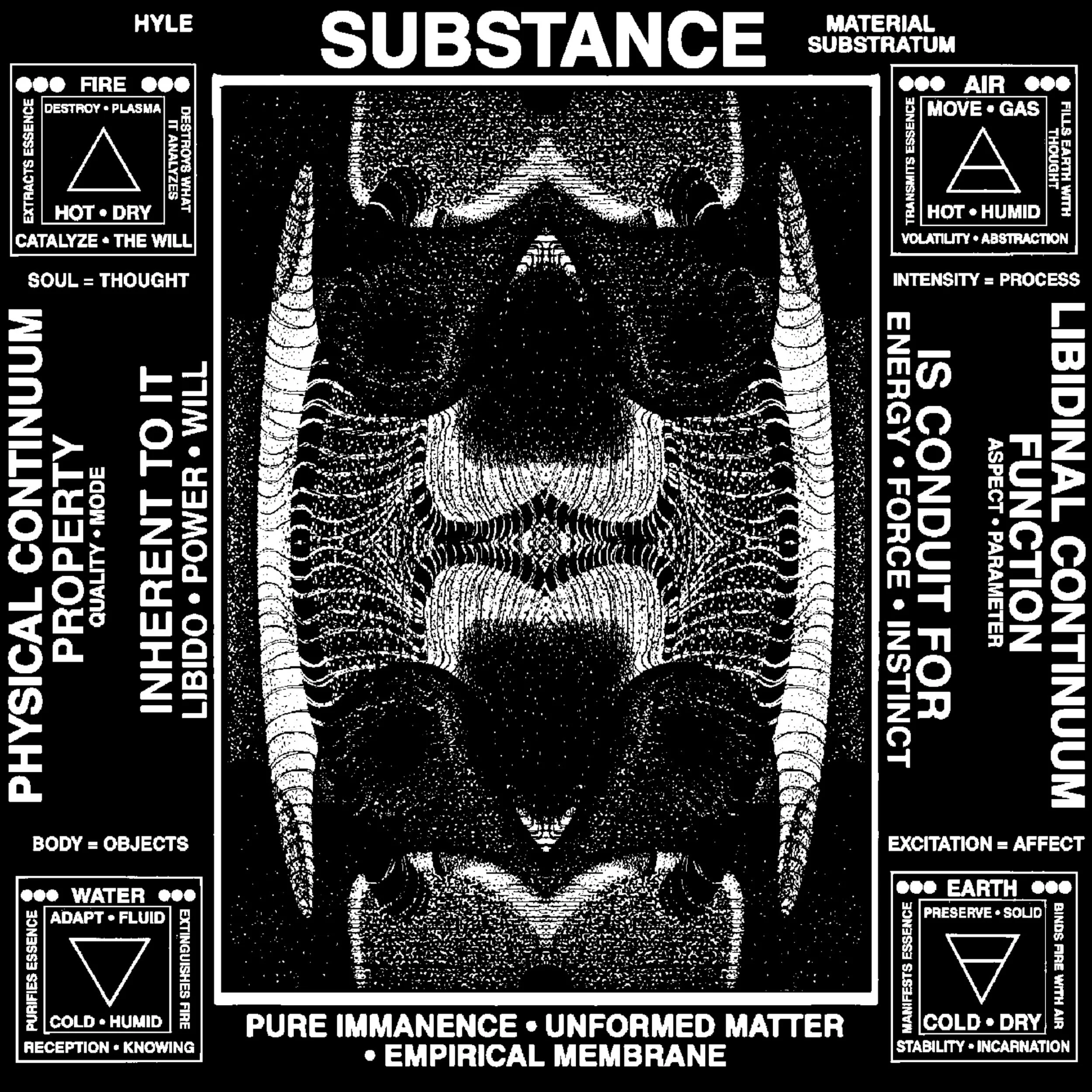
The Essence and Aura of Su libidinal continuum is conduit for Energy, Force, and Instinct. Nature is governed by the corpuscular influence of Function and Property.
Nature is a mirror to the metaphysical and surface of the Abyss.
[Its physical continuum is called nature. Nature is the empirical membrane—inherent to it is Libido, Power, and Will. Nature contains neither eyes nor mouth nor extremity. With no hands to grasp, it reaches toward nothing. With no feet to walk on, instead, it slithers. The elements unite under its shroud. The accidents of Substance reflect how the Absolute is mutilated in relative states of distribution.
Substance is whole, all material species, formed and unformed alike are included in its modes. The essence of all things saturates its anatomy. Pure immanence lies beneath nature—its libidinal continuum is the conduit of Energy, Force, and Instinct. Nature is a mirror to the metaphysical and surface of the Abyss.]
Substance holds a tangible mirror Pure immanence lies beneath nature—it calle. The libidinal continuum is conduit for Energy, Force, and Instinct.
Substance and Form are their own cause. Necessity and Reason are the source of cause as such.
[Form is the One in itself. Substance
==
The underlying base of Substance is called field. As such, Field is the essence of Substance and its corrrelative aura. As Essence, Field is the undimensioned ground of being overflowing with the ever-changing process.
===
The One
At the center of Thought's focus is the idea. The Idea is that of uncreated being–the unity of Form in all variety sustains a shapeless, unchanging conception of itself as one. The One which reconciles modalities and patterns–
TK
Necessity makes all things a cyclical exchange of Flux
===
In all things everywhere there exists a chain of expansion and contractions, in effects and their causes, of pure thought which enters being or pure relinquishment which lets go of thoughts but allows them dimensionality.
Contraction is a germinal nexus of functions—the transcendental condition of and toward causation. Contraction holds the elements together–it preserves and it creates. Existing would be an inconceivable space without reference if it ever stopped.
The self-affirming modality of Contraction is called thought. Thought is the pattern universe breathing inward to a center and volume–interior growth via endless recessions from the peripheral space of non-being toward a critical notion.
Expansion is the tangential pattern from cause to effect, without which existing would be a point needing breadth. Expansion separates these functions into visible orders of magnitude at a matter of degree.
The modality of Expansion is called relinquishment (Kenosis). Relinquishment is the negation of a center
universe breathing outward from origin to area–material growth via release from contraction: movement surrendering to rest, Thought losing its focus, expansion from temporal events
Relinquishment = self-undoing unmaking itself
Contraction expresses spontaneous activity and activities of the subjective consciousness. Expansion expresses the objective consciousness of physicality, objectless quietude, and immobile being.
The nexus of Function is Form, which follows from it. Their degree of separation is called Field. WSubstance is the irreducible remainder.
What comes forth is temporality, space, creation. Substance is the remainder
[At the center of Thought’s focus is the idea. The Idea is that of uncreated being: the one which reconciles patterns and modalities—the time and space of absolute life; the continuity of Spirit with Matter or the subject with the object. The One is the atonement of Being with Being—Dimension in itself and as such.
======
TKKTKKK - SPIRIT & SOUL
Spirit = Spirit is the unitary form of Thought at work in history.
Thought contracts to Spirit, descending to the plane of beasts so that Man may walk with the Earth’s surface with an upright posture.
History begins with Man, its memory, and writing. Man commits memory to writing—writing memorializes history, bringing the past into the present moment of the reader.
[Spirit reveals itself to Man when Thought records through Man and Man reflects upon the works of Thought occurring over eons. Man becomes a spiritual creature through the historical endeavors of its kind to be free and in their collective will to Reason. Spirit recognizes itself as Thought manifest by the community of souls in Man—temporally as History and Economics, and spatially as Politics and Law.
Soul - The Soul is Thought’s distinguishing substance at rest in space.
=====
USE SOUL TO SEGUE INTO THE ABSOLUTE DIFFERENT & ABSOLUTE SAME (E.G., the soul being the lunar intellect reflects the heavens above
[One bandwidth which can be divided lengthwise into two circuits. One strip makes the equator—the other makes an irregular circle around the poles. The outer circumference is predictable ]
[The movement of the absolute same and the absolute different occurs in Necessity’s greater cycle.]
[In the greater order of things, the sky bodies in the sky are given two movements—
The Absolute Same spins the heavens counterclockwise from the Earth.
The Absolute Different
[The Absolute Different precedes the unity of the One, as all variety of Form share in difference as such.]
[The Absolute Different revolves around the motion of heavenly objects
[Two circles; one
[The Absolute Same = the cycle of fixed stars contains the zodiac
[The sky displays the movement of its (absolute same) consistency. The seasons arrive then vanish, and return again with regularity. Night transitions to day—. Given sufficient time and position, the choreography of the heavens is a predictable phenomenon.
[In the absence of dawn, the night is all one knows—the night is meaningless without the opposing concept of day.]
The Many is preceded by the Absolute Same]
[The Many and the One support one another
The Soul is the
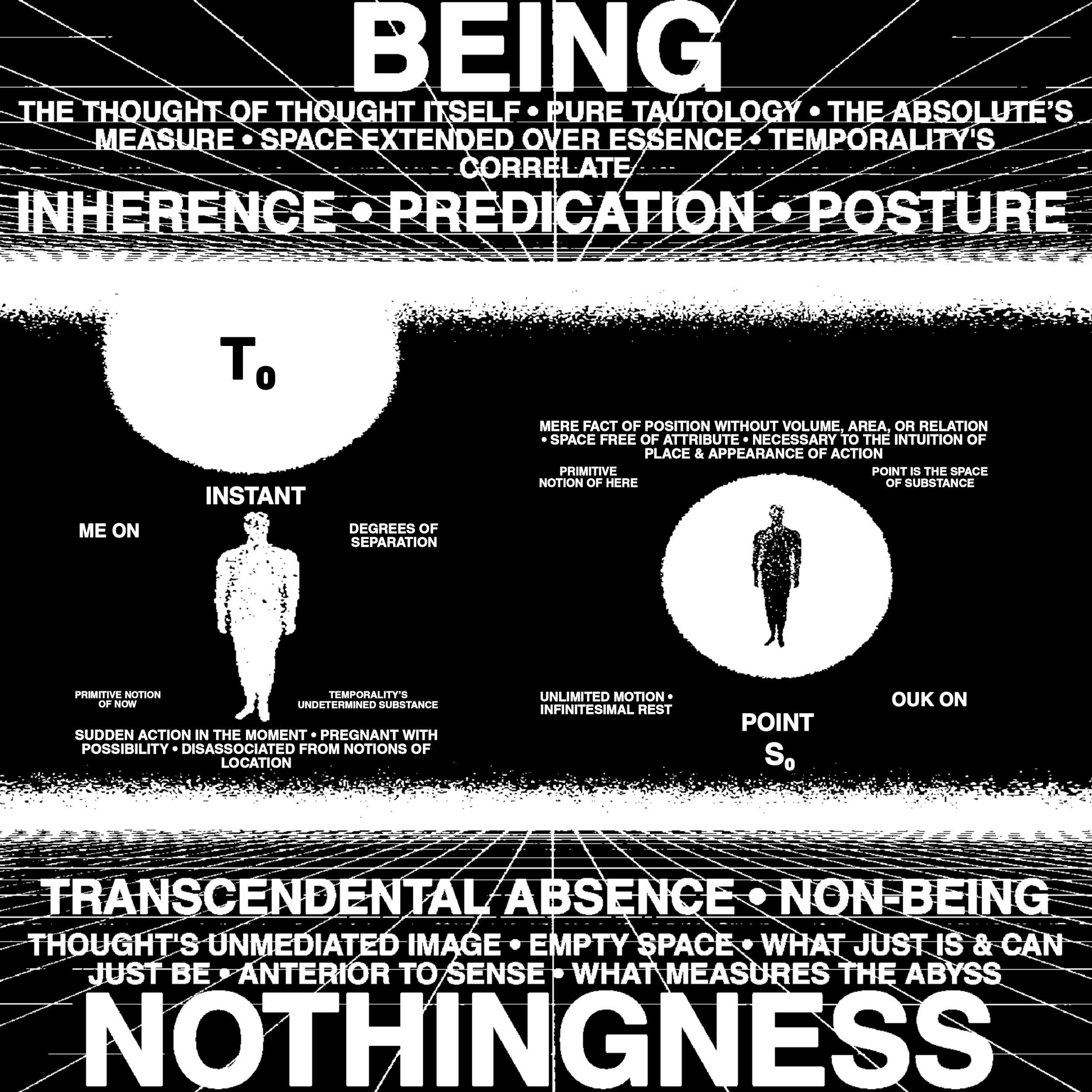
Thought is the pattern of growth in implicit contemplation with Being. Dimension orients Thought in relation to Substance within a coordinated system of measurement. Dimension is the perspective of Thought united with Relinquishment: Being's unconditional predication that Is, its pure inherence Here as space, the hyper-present Now at harmony with the past and future of time.
Dimension in itself is not of the abstract but of pure abstraction–not of the concrete as such but what predicates existent concretion. Being is Dimension by another name. Thought and Dimension are one. Being relates objectively through Thought, sympathetically with Thought, and subjectively as Thought. Dimension in itself has no becoming and is that which always is.

Is represents Dimension's common root–that which commits to being predicated in existence, that which relates Here to Now, and the term which subsumes all others in predication. Predication imparts meaningfulness to formless Substance at a moment in situ. That which defines Being Predicated is. Nothing exists beyond what Is. Being Predicated is neither object nor creature, not an instance of being, not that which merely occupies space but rather tautology itself–that of being predicated without further qualification. Here and now modify the term Is to include the existential being predicated in space, time, and Substance.
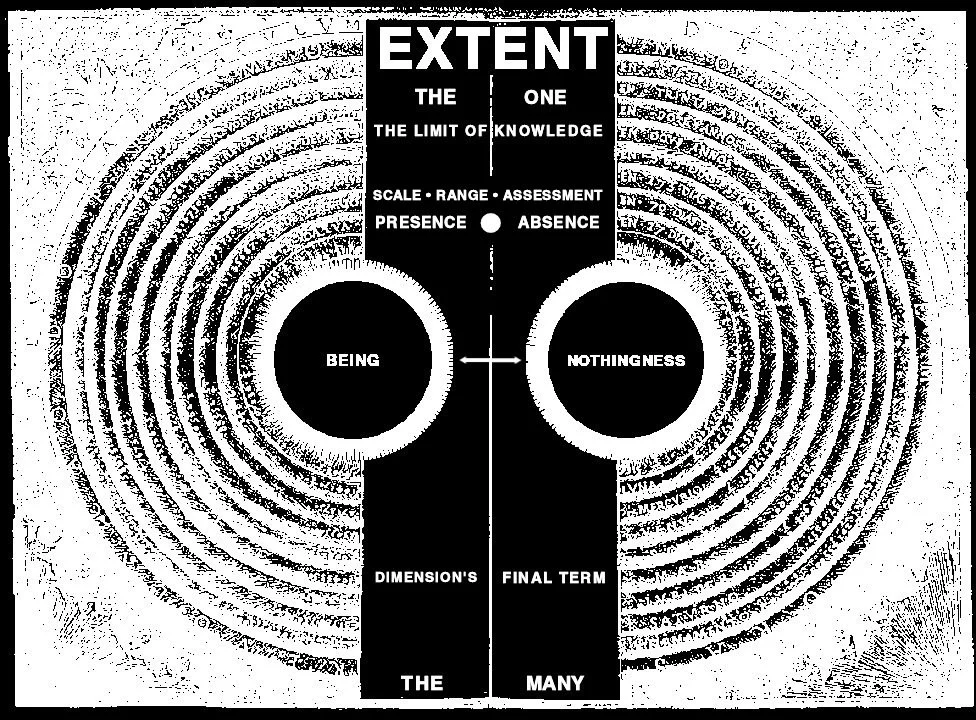
To be is to dwell immediately as such. To dwell is to be Here and Now–here, now, is are fundamental to existing, as existing is fundamental to knowing. To know Dimension, Thought must first apprehend the intensity of its property then and now, the quantitative proportion of its extension here and there, and the ontological extent of its being as one and as many. To know the properties of Dimension, Thought must work backward from the Extent of Dimension–from absence and presence to the corporeal nature of Existential Being. Property, Proportion, Extent are transcendental to Dimension and, as such, to space and time—Here and Now.
Property involves the aspects and parameters of Dimension. Proportion involves Dimension’s multitude, its magnitude, and the ratio between pure quantity opposed to that of a discrete number. Extent involves the scale of Dimension, its range, and the calculus of its assessment. Dimension makes itself as such in its occupancy Here and Now–opposes itself as such in growth and in thinking. Dimension that opposes itself knows itself as Thought. Dimension that remains unaffected disengages Thought as Relinquishment. Dimension is thus the thought of Thought itself and Thought's image of Nothingness. In itself Dimension has no difference—change is possible only when Dimension opposes itself mutually as Nothingness and Being.
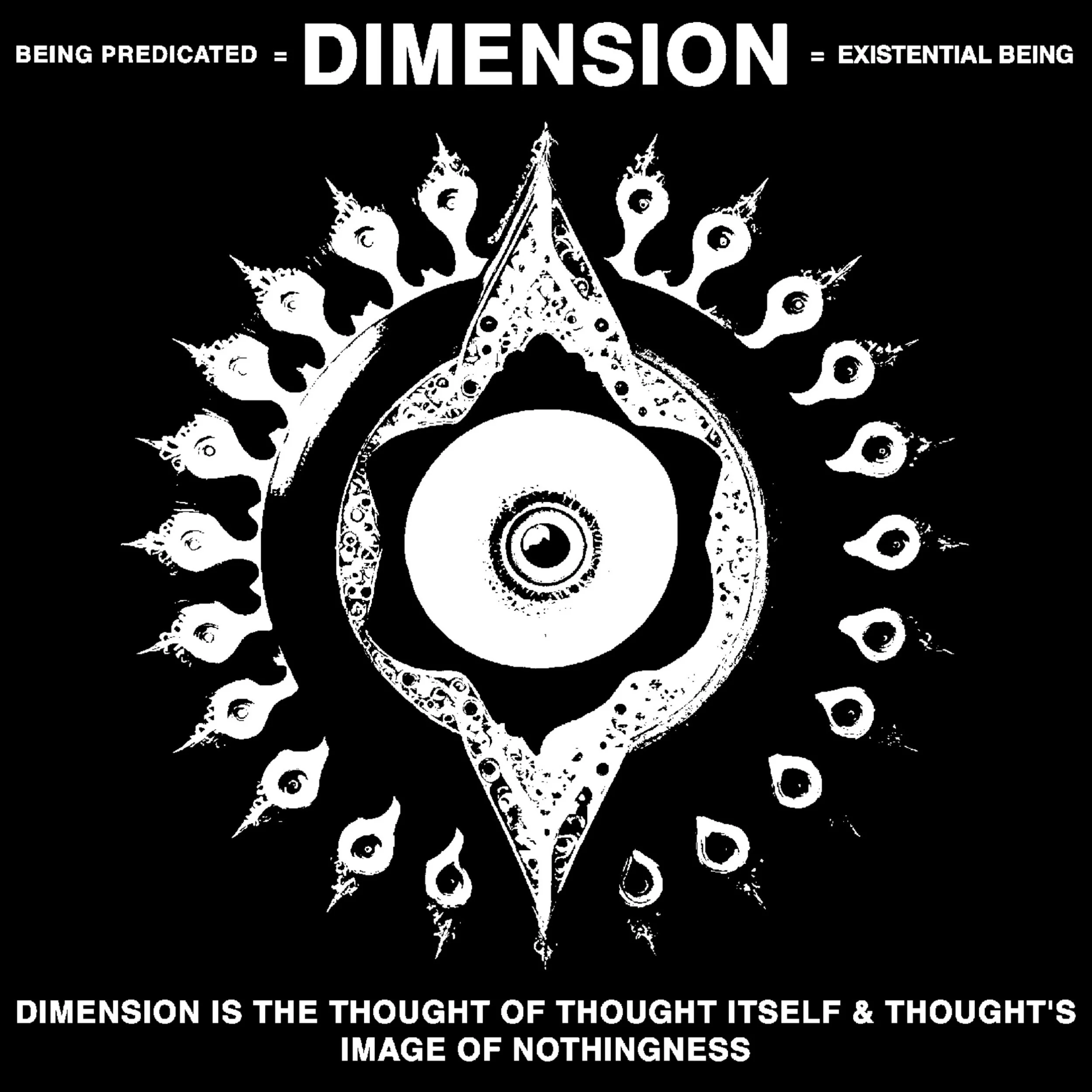
Extent circumscribes the absence of things equally with pure, immediate presence, yet the term also separates them from one another. Encompassing everything abstract, concrete, and real, Being is—complete, undying, and immutable. Being is Dimension’s undetermined Property—Thought apprehended as presence that Is, Here, Now without mediation. The content of Being is nothingness as such.
Nothingness, like Being, is Dimension without magnitude or quality–a primitive term isolated from other accidents, implying is in its simplicity, a here alien to tactile sensation, a motionless now that anticipates movement. Intimate with itself and anterior to sensation, Nothingness presupposes subjective prehension. As the correlate of negative space, it is ancestral to light, color, texture, sound, and fragrance. Total absence holds Thought's attention long before it is distracted with chromatic Property.
Nothingness does not oppose Being, as much it opposes phenomena, yet consciousness still perceives vacancy as its own existing status which affirms itself as being. Nothingness is Being which contradicts Being—a notion too sterile to be abstract, too fertile and undefined an idea to be called concrete, yet indistinguishable from the cavity it devours. Like Being, Nothingness also is. “To be is the immediate term which can be conceived,” says Thought. “To contemplate a presuppositionless notion so direct and absolute is to have thought nothing of definitive substance.”
Nothingness and Being represent the breadth of what is, what can be thought, what can be known. One term does not submit to the other. Being endures now at all instances and here at all points. Nothingness is as Being is, is implicitly here as Being is here, and eternally now yet it is the omission of everything besides Dimension. Together, Nothingness and Being are moments in Flux. The boundary between them belongs to neither absence nor presence. balance of Nothingness and Being is Dimension in itself. The balance of a motionless paradigm and an unfilled vacuum without borders is the Extent of dimensionality. Extent is thus the limitation of knowledge and Dimension's final term.
PROPERTY
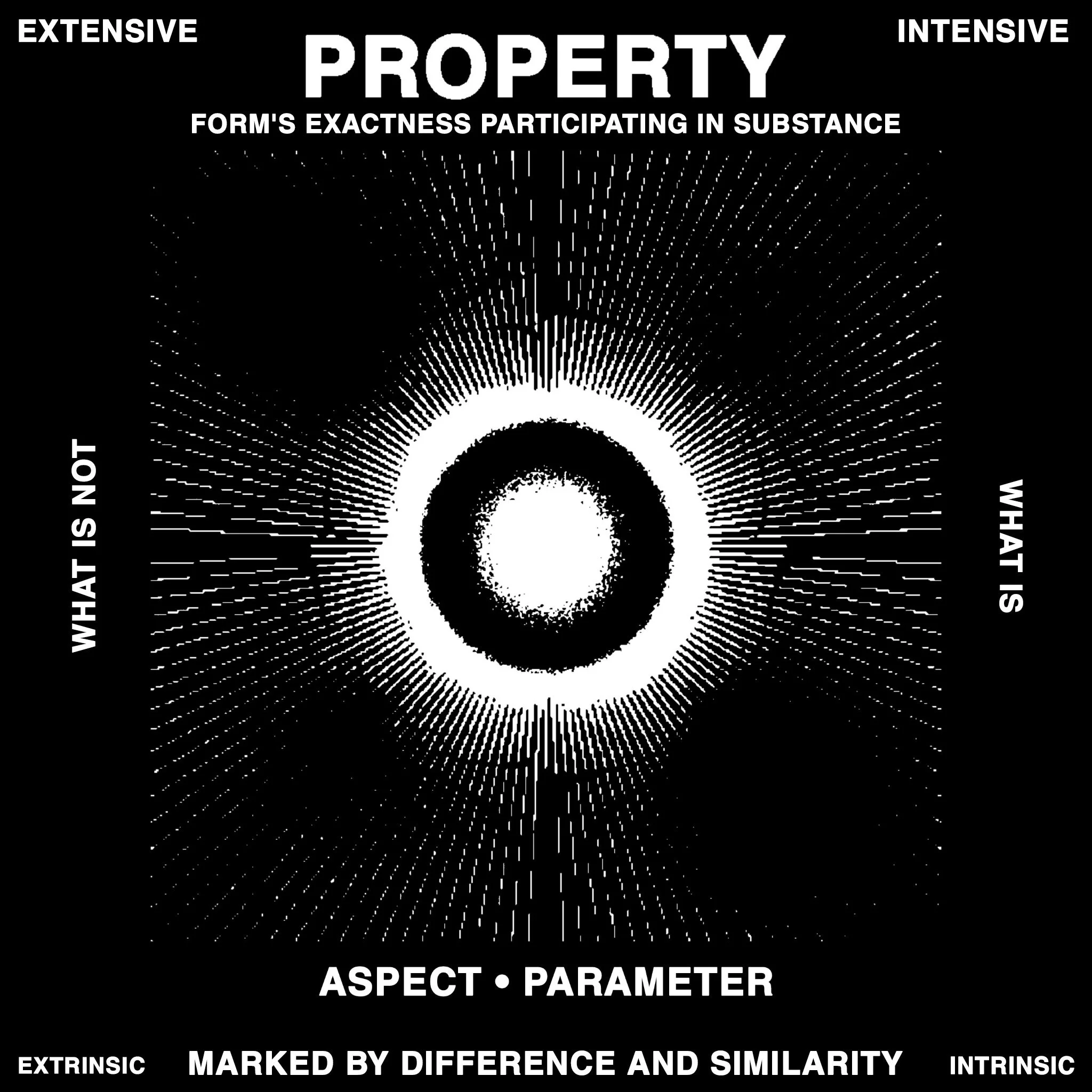
Intensity lies in the motionless foundations of presence. Intensity emerging from Mass is called property. Property expresses Form’s exactness inherent to material Substance of a particular kind. Substance participates in Property, physically and chemically. Fluidity, wetness, viscosity inhere in the substance of water. The substance of water participates in the properties that define it as such.
Property is Dimension in the first term and in opposition—for itself but also for another. The property of an object depends on its context. The context of Property is called aspect. Aspect establishes a barrier between intensities—the different relative to context. Property as such does not continue to be a property of a certain kind without intensity crossing this threshold.
Out of negative space, something alien manifests in the foreground.
In the absence of dawn, the night is meaningless
Sunrise negates the night sky. The starry objects remain but are no longer visible. It is called dawn because it is no longer night. In the absence of dawn, the night would be meaningless. Without the opposing idea of day, all one could know is night.
Property concerns the aesthetic sciences.
Aspect may be the intrinsic characteristics of a thing that define its nature—its density, color, or saturation. Intrinsic property remains innate to Substance regardless of the conditions under which it is determined. Intrinsic property is thus a mode of Substance.
Aspect may include a thing’s extrinsic qualities which depend on the magnitude of its substance and its relationship to other things—its mass, weight, or length. Extrinsic property changes depending on external conditions of Force. Extrinsic property is thus an accident of Substance.
[Non-being is the opposite of Aspect, but is a property of the negative.]
Property’s intrinsic characteristic is called intensive. The object’s extrinsic quality is called extensive. Extensive property represents divisible species of appearance.
Mass is an extensive property of Substance but an intrinsic property of a particular object.
The extensive does not identify its substances but is dependent on Mass nonetheless. Rather, the extensive is that which the Body can grasp and that which is ultimately unaffected by the encounter. Intensity is that which is grasped by Thought but remains unaffected by Thought.
Parameter represents Property as a quantifiable factor whose value is reliably intelligible and remains constant in temporality and space. It is Property characteristic of a kind of Substance.
=====
Dimension, for itself, in the first term and in opposition to another, is called property. Property determines something, what is, as a contrasting feature to relative non-being, what is not. The entity ceases to be what it is when its properties are lost. The rising sun negates the night sky. The sphere of fixed stars remains, but the stars themselves are no longer visible. It is called dawn because night dissolves into morning. The total absence of dawn makes a meaningless notion of the night. Without an opposing idea of day, all one could know is night.
Property’s intrinsic characteristic is called intensive, and its extrinsic quality, extensive. The extensive refers to properties of Substance which depend on the quantity of matter present in the object–that which the Body can grasp and that which is ultimately unaffected by the encounter. The extensive is spatially distributed and divisible, while remaining the same in kind. Intensity refers to properties determined by the degree of magnitude or density at a point. The intensive remains indivisible, gradient; as such, it does not decompose into measurable parts. Intensity is that which is grasped by Thought but unaffected by Thought.
The immediate appearance through which Property expresses itself as something–recognizable, unique, and solitary is called aspect. Aspect orients itself toward the world; intensive variation underwrites its affective potency. As such, Aspect correlates to what is felt, what appears, and what changes. The boundary that delimits an aspect is called parameter. Parameter establishes the coordinates through which Property becomes comparable and the conditions within which intensity becomes arrested. As such, Parameter represents how appearance becomes measurable, how what is felt is communicated, or how what changes becomes stable. Parameter is thus Property within the conditions of circumstance and contact.
Notes about Proportion
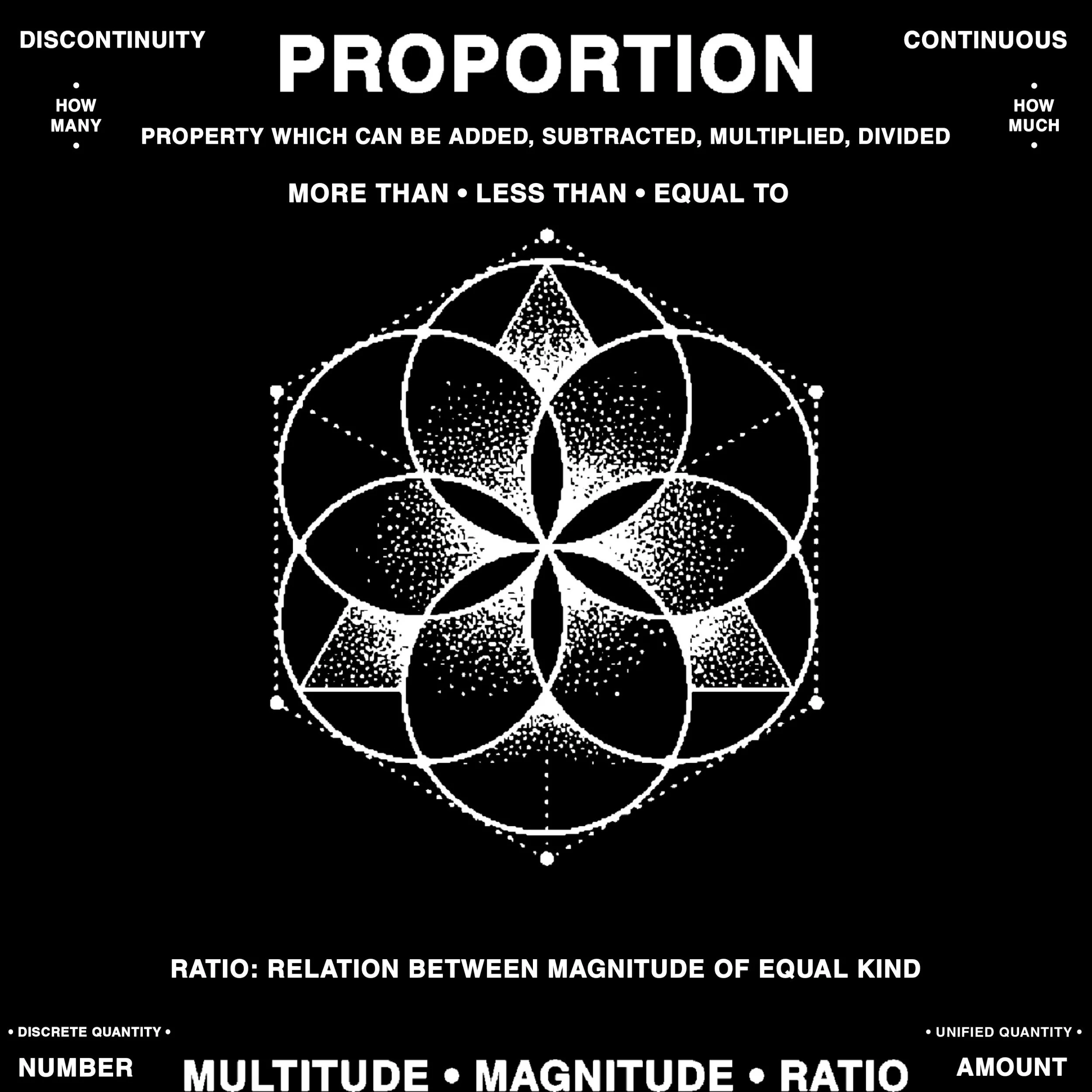
The substantial unity of Property is called proportion. Dimension through Property makes Proportion a necessary condition of Being. Proportion represents a type of Property imposing a quantified limitation upon itself, in equal quotient between parts of a whole or the whole itself.
Proportion is Property whose aspects can be multiplied or divided from itself; or subtracted and added to the whole–it is Property whose parameters exist under the terms magnitude, multitude, and ratio.
Under the term Multitude comes the property of discontinuity and number. Multitude is discrete quantity—countable by its nature.
Multutide determines pure quantity as such.
The property of a continuous amount appears under the term Magnitude. Magnitude is Property’s measurable aspect determining the parameters of a quantity—how much of a number.
CATEGORIES TK
“I can grasp the multitude in finite quantity,” says Thought. “Its magnitude, however, cannot be understood without common limitation—without establishing the extent.” The Soul finds meaning in the Extent of dimensionality. Dimension in Assessment derives judgment and measure from spatiotemporal categories that determine conditions in which consciousness experiences. The predicate does not limit its subject—the range of possibility is limited insofar as what is not the subject is excluded from the infinite sphere of indefinite terms. Thought’s infinite judgment establishes the genetic conditions of material things and the appropriate precepts of their being.
Dimension communicates with itself—its precepts are the incommensurable language of Being in dialogue with Being. The object of knowing speaks to the subject of knowing—the knower reciprocates with the object observed. Being, living, and knowing are mutually applicable notions. Precepts represent necessary elements of understanding that issue from the nature of consciousness. The taxonomy of predicates define the terms of Range, meaningfully interfaces between individual dimensions at Scale—providing richer definitions of time and space, and are a necessary feature of Assessment—as such requiring a spatiotemporal dimension to describe.
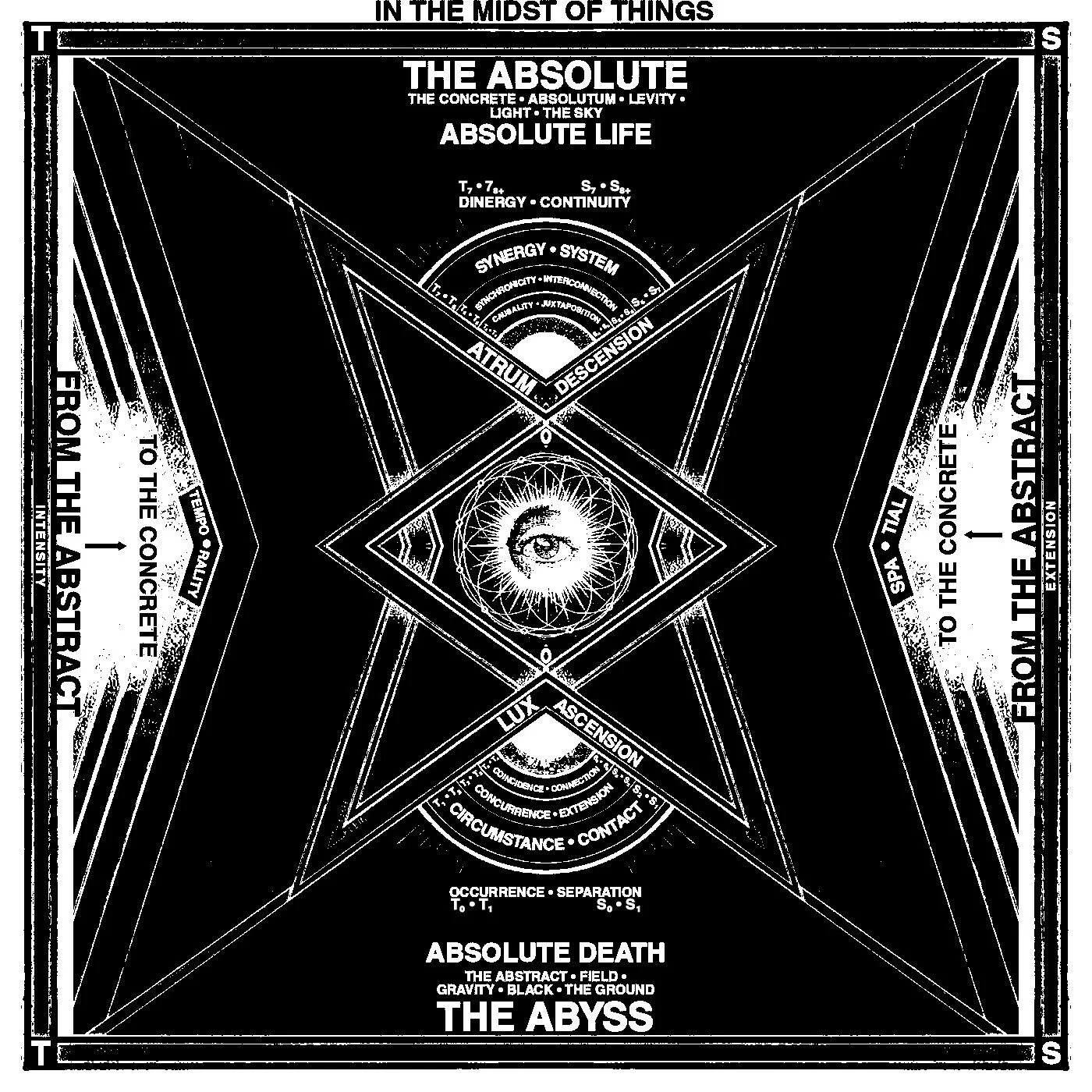
Consciousness cannot produce coherent notions without the precepts of its understanding which make experience possible. A fact cannot be determined without them—experience must conform to their doctrine even as conjecture or belief. At the smallest temporal origins is occurrence and at its totality, dinergy—continuity at the spatial zenith and separation at its lowest point. They are categorical and epistemic but are either absolute or relative as the former or the latter. If the precept can be called categorically absolute then it is an epistemically relative category. If it is epistemically absolute then it must be called categorically relative.
The Soul does not perceive Occurrence any more than it senses Continuity. The knower perceives an accident that occurs, but not occurrence itself. The knower detects a regularity of space that it appreciates as continuous but not continuity as such. The Soul senses neither Causality nor Separation, but comprehends the causal relation between bodies in motion acting upon bodies at rest as causality or the length between objects as separation.
The precepts of space represent definable points of reference—altitude, longitude, or latitude. A geometric figure is never without the environment upon which it inscribes its coordinates. The temporal precepts are variable instances in which the novel becomes possible at the material level of expression. A narrative cannot be without its central focus—
((precepts of space = [altitude, longitude, and latitude are properties of space, not the object]// Separation at the juncture of a point becoming a line. Contact at the transition of line to a plane. Extension between the plane as it becomes a three-dimensional solid.
(((Precepts of temporality = Occurrence at the critical moment of an instant becoming an interval of time. Circumstance between the interval and its passage into a succession of intervals. Concurrence of a succession to a continuous duration. Coincidence of a duration to that of phenomenological time. Causality at
To be categorically absolute is a genus of being independent of relation—it can be conceived without presupposing the object. To be categorically relative is the state of being fundamental yet incomplete—a certainty that presupposes a dependency. It can be called relative because it can be called dependent on an action or an object.
To be epistemically absolute is to be that which necessitates comprehension—a category of knowing intrinsic to every subject of knowing. To be epistemically relative is to be a category of knowing dependent on the object external to the activities of Mind.
The categorically absolute does not require a subject. The categorically relative cannot exist without its host. The subject requires the epistemically absolute to know. The epistemically relative is a derivative quality of an object relating to the subject.
The taxonomy of predicates define the terms of Range, organizes Scale, and are a necessary feature of Assessment—as such requiring a spatiotemporal dimension to describe. assessment of dimensional Extent. Scale is the graduated series of ascending and descending order that spans Dimension. Thought climbs the heavenly
Range encompasses the dimensions over which the influence of space and temporality take part. In isolation, the dimensions constitute subdivisions of Extent. All together the dimensions produce Scale.
Intensity and the extensive are not just momentary states of Property but also the terms of its assessment. Assessment is the subjective appreciation of a dimension’s character. The Soul comprehends by Assessment, dwells in Substance, labors in Dimension.
Dimension in Assessment quantifies Property, it is Proportion’s aesthetic judgment of Form and Substance. Assessment is sympathetic to the duration of properties—it measures proportions of space. Assessment makes here and now definitive artifacts of Insight within the Soul.
Poetics of quantity and number
Rational constitution of Property
The Soul does not perceive Occurrence any more than it senses Continuity. The knower perceives an accident that occurs, but not occurrence itself. The knower detects a regularity of space that it appreciates as continuous but not continuity as such. The Soul senses neither Causality nor Separation, but comprehends the causal relation between bodies in motion acting upon bodies at rest as causality or the length between objects separation.
ATEMPORAL/SUBSPATIAL
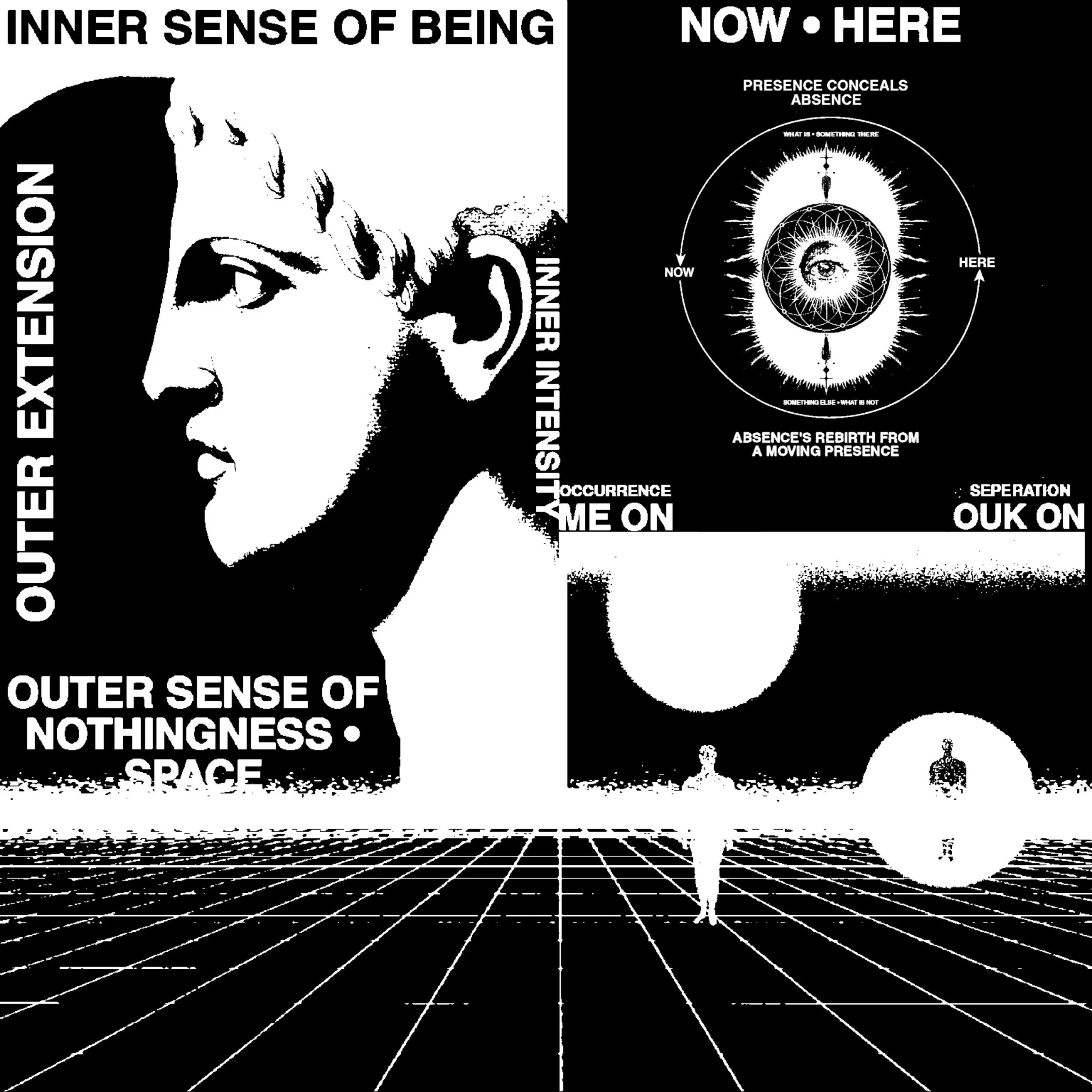
Separation = From the Soul’s appreciation of space, Separation makes infinite length between a local point here and a remote one there, opposite to Perspective. Line contains Point indefinitely—to Perspective’s deduction the figure of space is encoded with conventions of distance or proximity, of Line’s terminated segment extending from a single origin between any two points Here or There in either direction.
Occurrence = Insight is always an intuition. Intuition begins at the moment of Occurrence. Occurrence constitutes a pure idea of sudden action, of Now that is absorbent—categorical to intensity, to experience, and to its passing, but blind to causal relationships. Occurrence is essential to knowing irrespective of place, distance, or proximity. With now comes the possibility of Insight as such—that of absolute knowing.
The knowing of temporality is rooted in interiority and the inner intensity of living. Absolute knowing presupposes the potential subject of knowing. Now demands more attention than Here. Temporality conquers point of view—the inner life of Substance becomes synonymous with the Soul. The Soul is the knower by another name. Now is all that the Soul is and all that the Soul has.
As the fact of an instant, Occurrence delimits notion. Now: temporality connects action with Thought. Here and Now: The Soul enters pure simultaneity with the Body, but only implicitly and as Insight. The Soul’s notions of Perspective and Insight. The primitive simultaneity of action precedes the emergence of concrete descriptions that define its conflict. Occurrence is too immediate a category for the Soul to grasp—necessary to narrative but conspires against its very comprehension.
PROTO
Circumstance = beginning of Perception [Perception occurs at Circumstance in order of Succession]
Contact = Perception constitutes the boundary of Contact.
[Perception knows only of the present and the Real. The future and the past cannot be perceived by touch, sight, sound or taste—events are either too slow over spaces that are too far to be observed, or they are a consequence of unintelligible causes that are too small and transpire instantaneously.
EO
Concurrence = Concurrence of Memory with Perception
[Memory knows only of the past
Extension
BIO - [The ancestral voice of a billion dead lifeforms written across history reverberates throughout the organism’s synapses—from the root and up along the spinal column to the sacral. From the navel bonding organism to species, up to its beating heart which keeps the rhythm, and to the throat connecting the inner world with the external environment
Coincidence =
Connection =
NOO
Causality = [Causality is the definite limit of Perception and the beginning of critical Analysis. Analysis is Insight in and for itself — the relative knowing of the Equidistant, of Perspective, and of knowing as such. Causality describes the beginning and ending of personal narrative.]
Juxtaposition =
SOCIO
Synchronicity =
Interconnection =
SACRO
Void =
Hyparxis =
Synergy =
System =
TRANS
Dinergy =
Continuity =
BEYOND
Range is the territory of knowing—the dimensions within which all forms and substances can be intuited, perceived then committed to memory, analyzed, or imagined. The dimensions themselves do not constitute a higher ontological order. The precepts bridge divisions of Range—there is no fracture between states of Assessment from
[A line exists in the incommensurable category of a plane just as time exists within the determinacy of eternity]
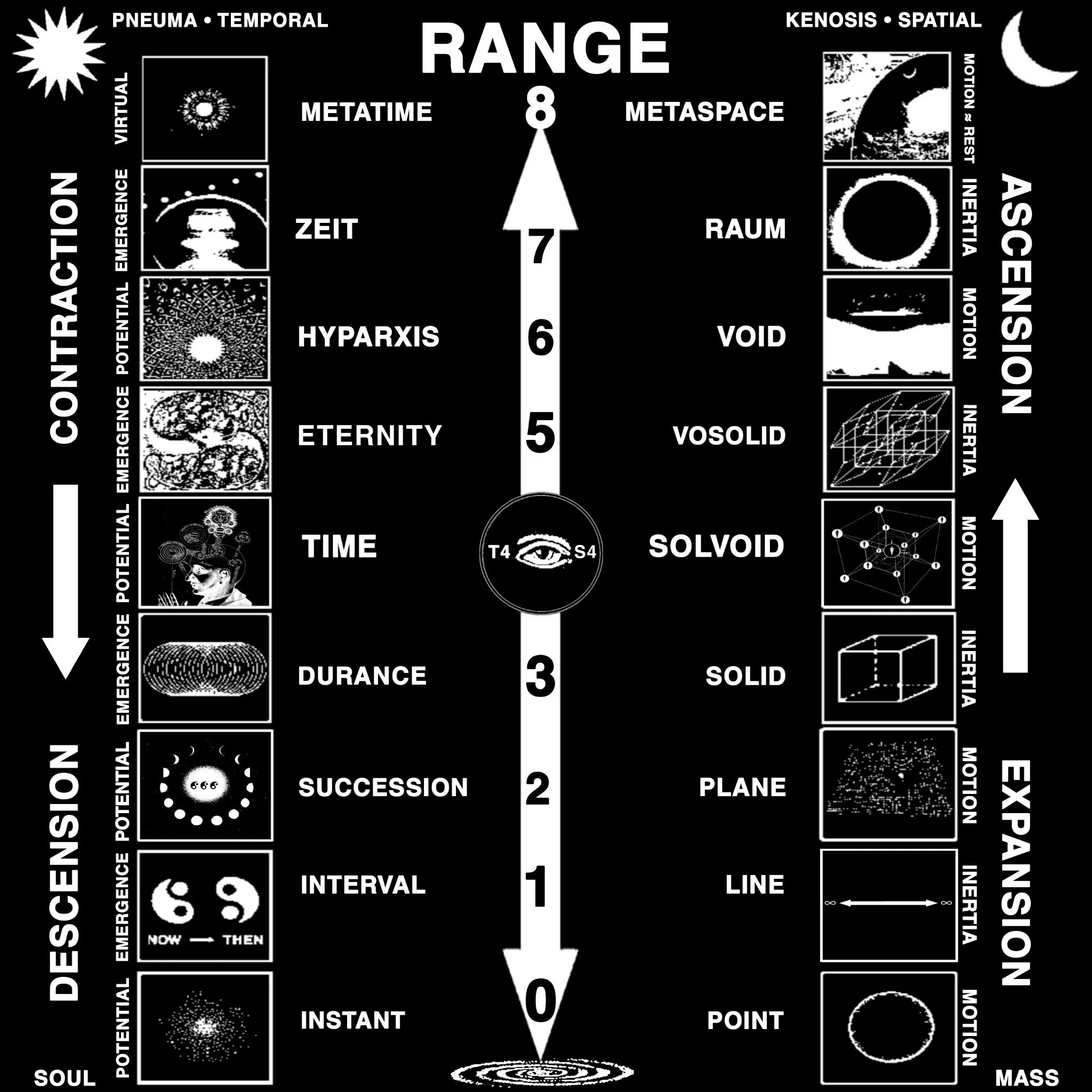
Range encompasses the dimensions over which the influence of space and temporality take part. In isolation, the dimensions constitute subdivisions of Extent. All together the dimensions produce Scale.
==
A transcendental derivation of the most fundamental criteria of knowing seamlessly coincides with an exposition of the most general and necessary conditions of being
==
Scale is the graduated series of ascending and descending order that spans Dimension—the extent to which the precepts can yield knowledge. Thought climbs the heavenly ladder from the sky to the ground, returning from the ground once again to the sky. From the sky, Thought acquires the fruit of wisdom to germinate beneath the ground. From the ground, Thought harvests the fruit of creativity to consume on its expedition to the sky.
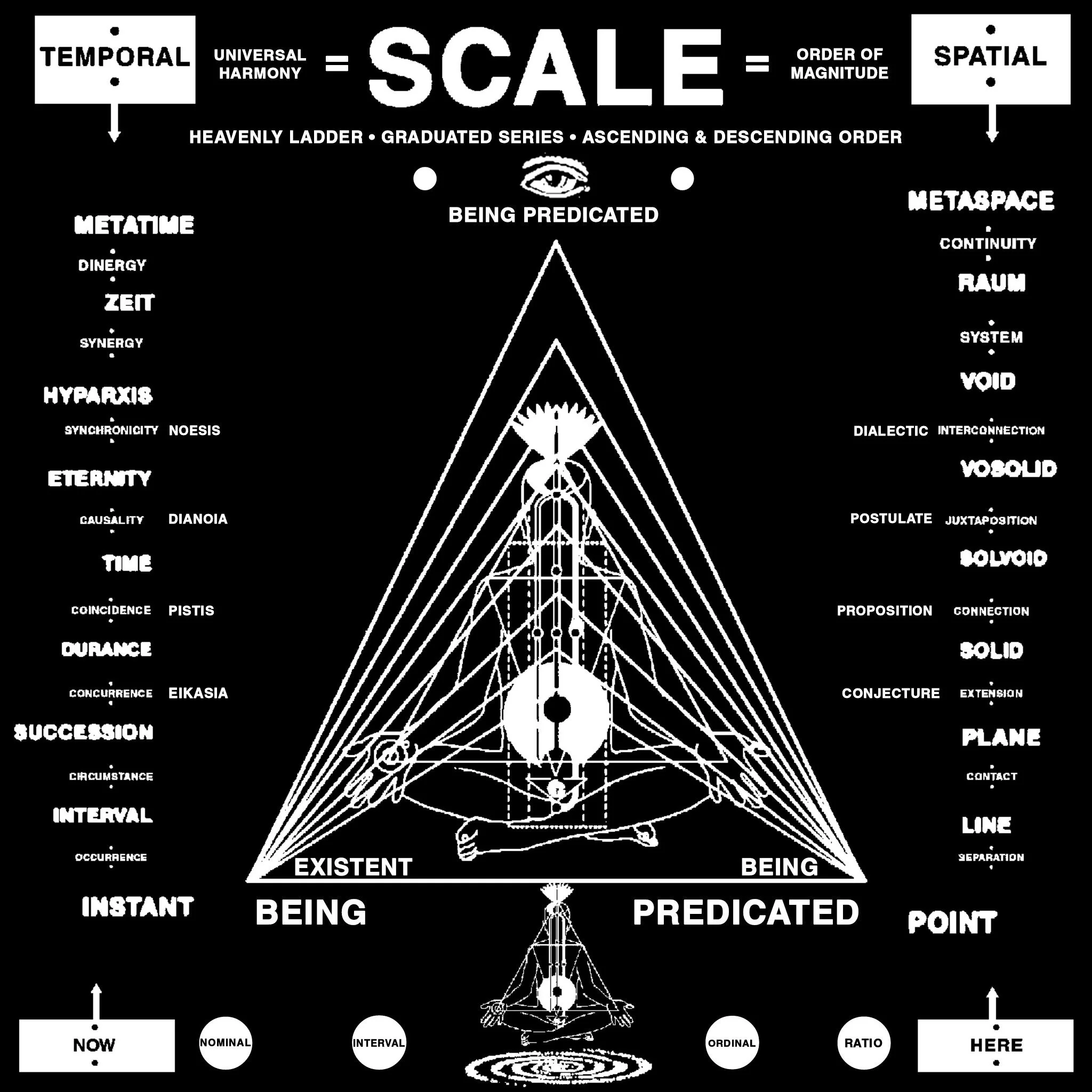
Scale is the graduated series of ascending and descending order that spans Dimension. Thought climbs the heavenly ladder from the sky to the ground, returning from the ground once again to the sky. From the sky, Thought acquires the fruit of wisdom to germinate beneath the ground. From the ground, Thought harvests the fruit of creativity to consume on its expedition.
Scale connects Absolute Life with Absolute Death.
As it expands through Jupiter to Saturn and to the Moon,
Nominal - Nominal scale, categorizes Property as a variable without implying quantitative value.
[Nominal scale indexes variables by
Interval - Interval scale
Ordinal - Depicts the order of variables but not their difference—the variables of Proportion and Property are grouped by quantity and type, then ranked accordingly.
At the ordinal scale, the variables of Proportion and Property are categorized and ranked.
Ratio scale-
its distance from zero is not arbitrary. absolute value
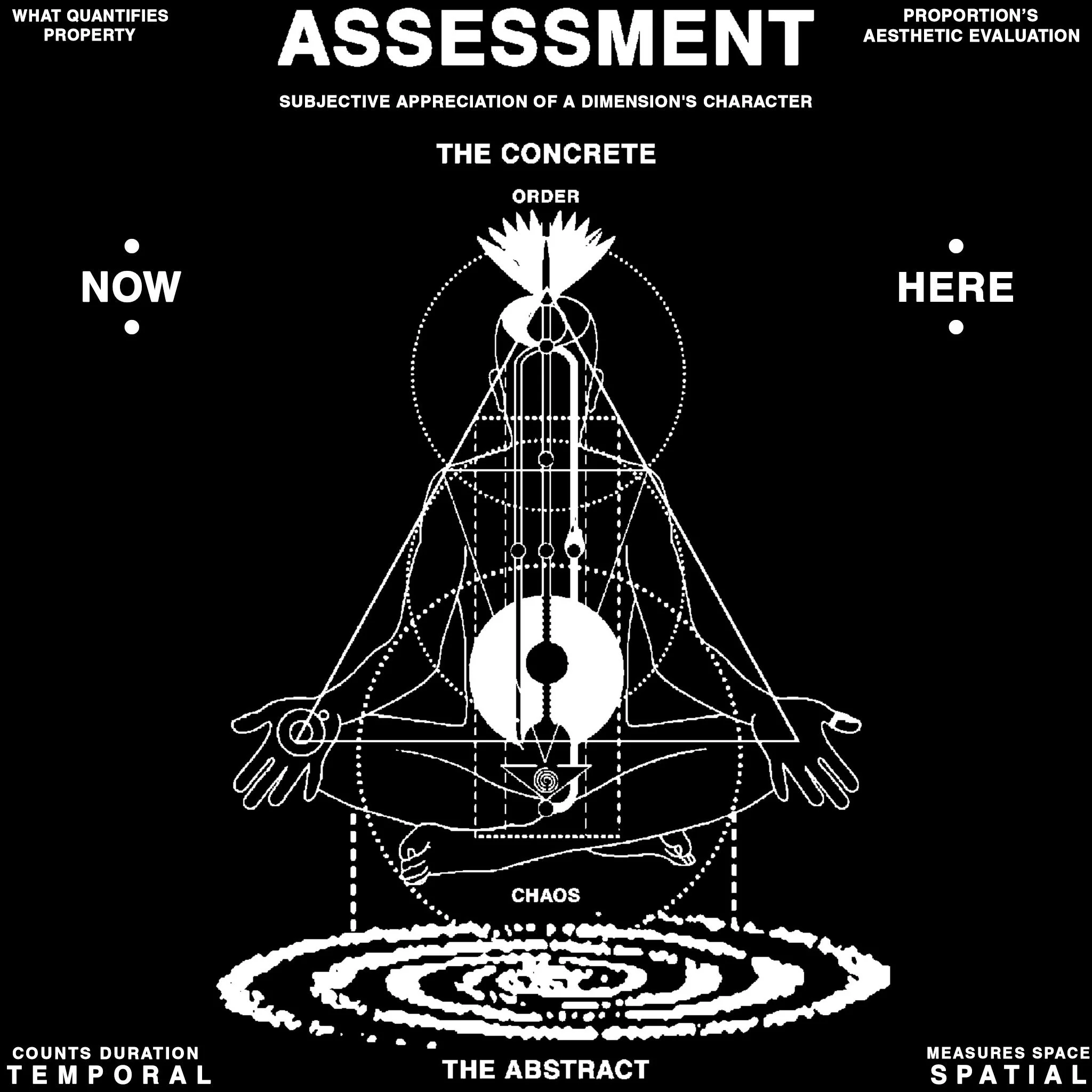
To assess the object’s dimensions is to critique its properties against its proportions.
[Issuing from Thought, which has reduced itself to is, Assessment begins not with Form nor Substance but with being and knowing derived from Scale and Range. Thought comprehends with Assessment which labors in Dimension to know Substance and Form. By its labor, Assessment demonstrates what Logic does—the pure enterprise of what it is to know and the dimensionality of what predicates existing. A transcendental derivation of the most fundamental criteria of knowing seamlessly coincides with an exposition of the most general and necessary conditions of being]
Assessment is the criterion of dimensional analysis. The Soul comprehends by Assessment, dwells in Substance, and labors in Dimension. Dimension in Assessment is Proportion acclimated to the rational constitution of Property. Dimension in Assessment quantifies Property—it is Proportion’s aesthetic judgment of Form and Substance. Assessment is sympathetic to the duration of properties—it measures the proportions of space. Assessment makes here and now definitive artifacts of Insight within the Soul.
Assessment is the subjective appreciation of a dimension’s character. Property is sympathetic to the poetics of quantity, number, and degree.
==
ASSESSMENT NOTES (USE VERBATIM)
Assessment begins not with Form nor Substance, but
Assessment demonstrates what Logic does—the pure enterprise of what it is to know and the dimensionality of what predicates existing.
A transcendental derivation of the most fundamental criteria of knowing seamlessly coincides with an exposition of the most general and necessary conditions of being. Assessment is an account of Scale. Scale is a measure of Range—Range is the territory of knowing and being.
--===
[In modalities below Analysis, the Abstract escapes representation and cannot be rationally comprehended. Rather it is something felt—something accessed by Intuition and Imagination exclusively. The Abstract transgresses consciousness, exceeding the limits of its experience
The Concrete is reality’s autonomous, objective structure that cannot be perceived independently of the real. Instead, it is what representation attempts to capture and is identified in objects by Memory or Analysis. The Concrete conditions the possibility of a real to be experienced by consciousness.
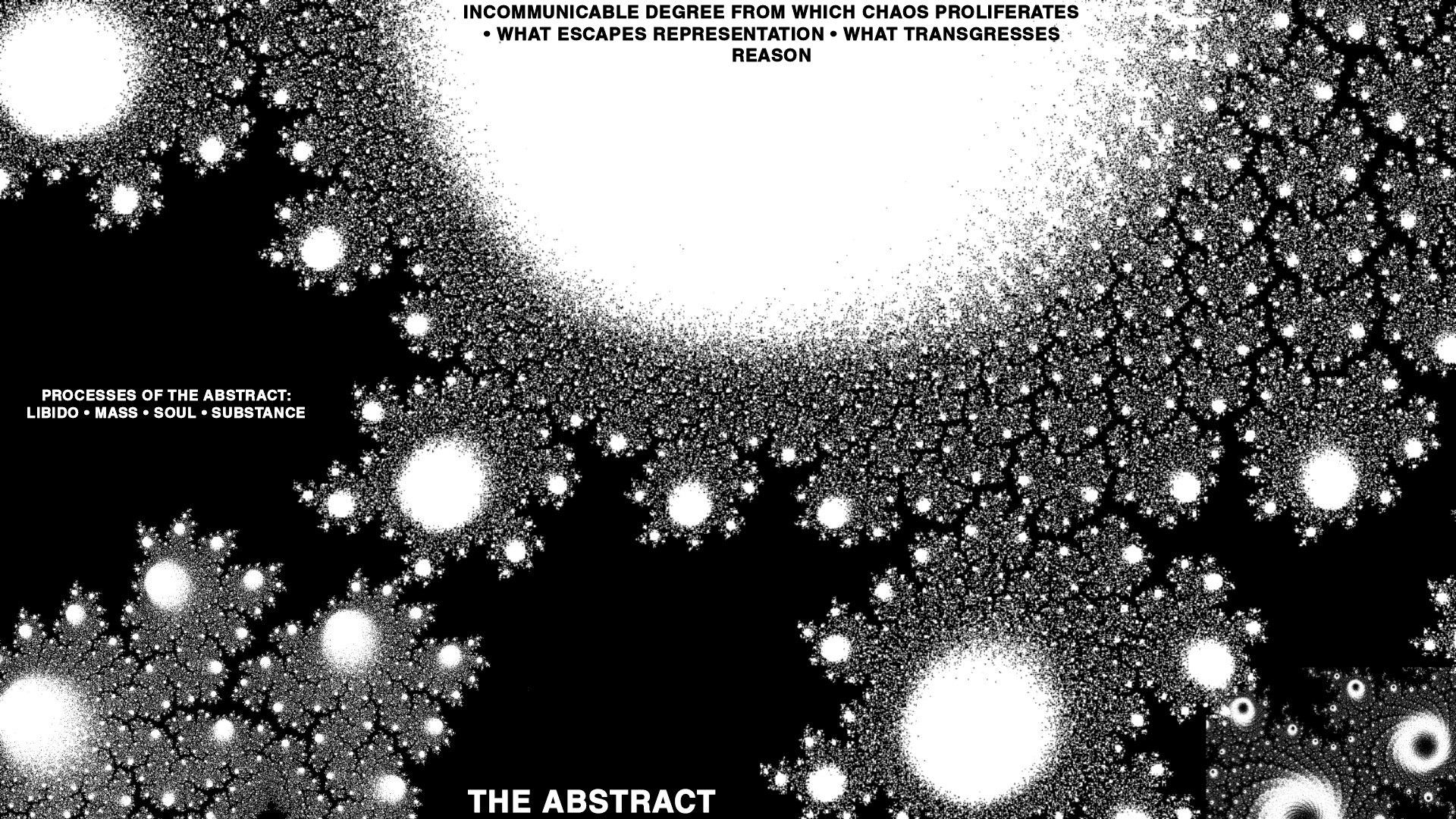
The Abstract concerns the future unfolding in space. The Concrete affirms temporality over space. The Concrete is the rational degree soliciting order. The Abstract is the incommunicable degree from which chaos proliferates and is thus open to interpretation—Substance answers to the Abstract, and Form to the Concrete. The Concrete contains Form with a minor amount of Substance. The Abstract is Substance with a total absence of Form. Substance overflows in the processes of Libido, Mass, Soul, and Substance itself. Form inscribes itself in the processes of Body, Spirit, Matter, and Form itself.
Concerning pure emergence of the future, The Abstract is space and temporality entangled. Affirming temporality over space, the Concrete is there but for a moment.
Substance answers to the Abstract, and Form to the Concrete. The Abstract is Substance with a total absence of Form. The Concrete contains Form with a minor amount of Substance. The Concrete pertains to aesthetic nonentities and ideal objects, which paradoxically makes it an abstraction. Likewise, the Abstract applies to immanent dynamics and is thus the source of material concretion. Form inscribes itself in the processes of Body, Spirit, Matter, and Form itself.
Conditions the possibility of a real to be experienced.
Between formal states and something completely amorphous is the Real: incarnated emergence—the actual available to Perception in the present. The Real is the object of empirical observation. The Concrete is the rational degree soliciting order. The Abstract is the incommunicable degree from which chaos proliferates and is thus open to interpretation.
==
ASCENSION/DESCENSION
DESCENSION
[Thought contracts to Spirit, descending in revelation to the knower. Revelation is the knowing of knowing itself—the transpersonal systemization of all categorical precepts, absolute knowing as such as such. Absolute knowing as such is the image of Thought with vision—the solar intellect in descension to the plane of Man, Mind, and animal.
may walk upright. Descension is the pursuit of absolute death by absolute life.
[As it descends through the Sun to Venus and then to Mars, Revelation transcends personal conceptions of a parochial is, now, or here.
Insight - a non-conceptual vision of Thought without image.
[The Sun’s descension illuminates the Moon—the lunar intellect emits the light reflected upon it.
====
Ascension is the journey into absolute life out of absolute death. Formless Mass expands to Matter. Consciousness radiates out of
The ascension of consciousness is the exultation of the Soul
represents the Soul’s passivity in space.
[As Insight expands through Jupiter to the authority of Saturn and to its private retreat in the Moon,
[The planets are the Sun’s wandering companions. Visible to the eyes of the knower from its center of gravity on the flat surface of the Earth, the objects in the sky and on the ground are harmonious. Their choreography interpenetrates with the Body’s movement below the heavens and the Soul residing in the Body. The planets affect terrestrial events but there is no direct influence on consciousness, except symbolic resemblance.
The seasons yield to the Sun as the tides yield to the Moon. The seasons resemble cyclical decay and replenishing growth as the tides resemble passionate excitation. What excites in the Soul and Body resembles the movement across the heavens. The events on the ground are as large as those in the sky—as those in the sky are as miniature as the passions below on the ground. As the Sun and Moon rise and set along the equator]
As the
Lateral with the Sun is the Moon, and below it are the elements.
==
I Lesser Work/Ascension==
1. SATURN = pure consciousness enters the night of the Soul. Saturn devours all of its children—by its powers of restriction and the subsequent perishing of its treasures, all that changes is returned to the Abyss from where it was borrowed.
2. Jupiter = empirical consciousness has raised itself from the elements
MOON -
II GREATER WORK/DESCENSION
SUN
VENUS - The Sun consumes the Moon
MARS
===
SAME//DIFFERENT - MOVE THIS TO THE EARLIER SECTIONS CONTRACTION/EXPANSION
One bandwidth divided lengthwise into two circuits. One strip makes the equator—
The Absolute Same turns the heavens counterclockwise
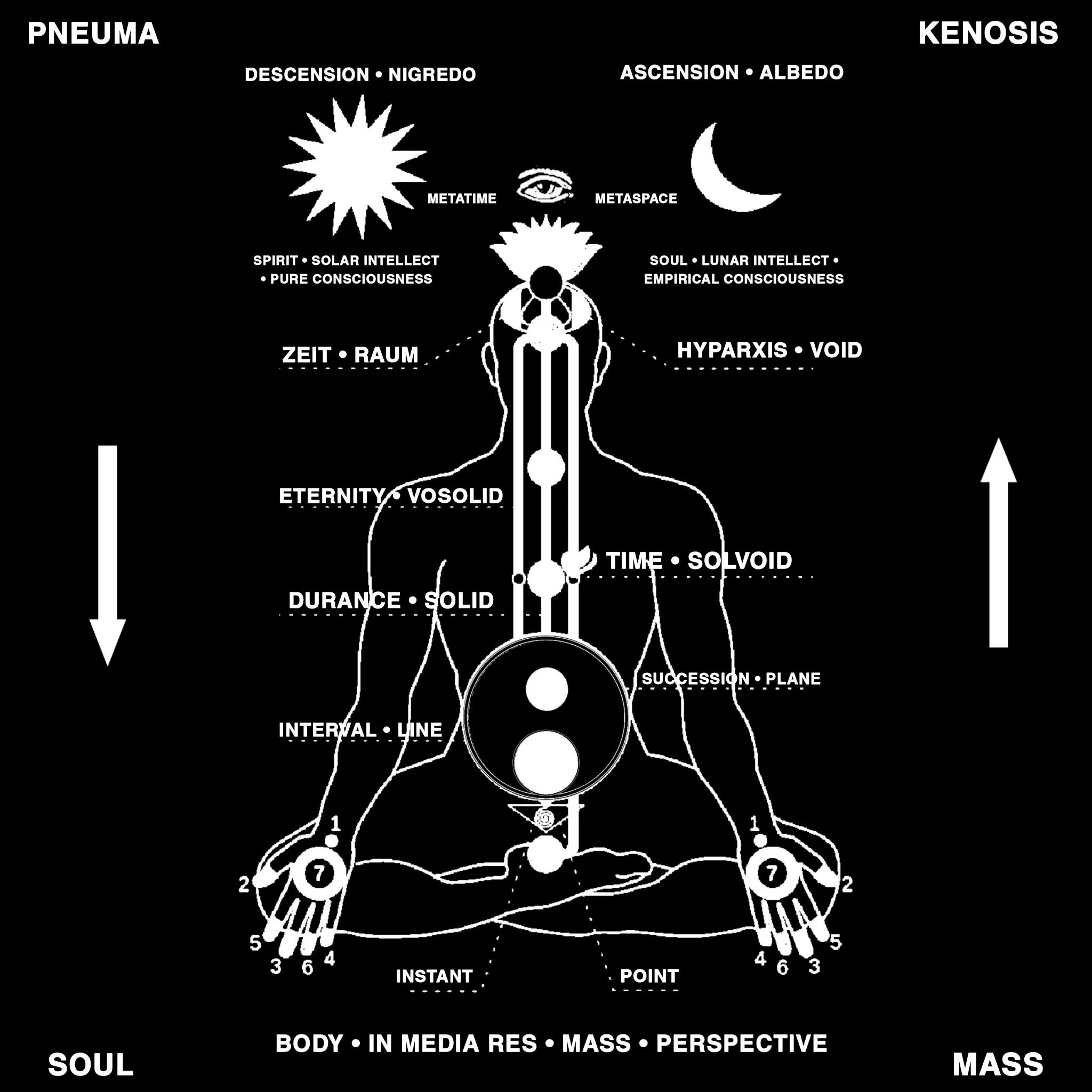
POINT
[Intuition grounds Thought at the undimensioned beneath the providences of Reason. Is, Here, Now are the undimensioned coordinates that shape the field of Intuition. At the Intuition, Thought takes hold of Here, Now, and Is, but affirms neither Property nor its Form, nor Proportion of Substance. Thought does not comprehend Dimension to be more than pure immediacy and the indeterminate—what is, what is now, and what is here. Is defines Being's inherent nature. Here and Now orients consciousness in knowing, as well as in being. As such, Is, Here, Now are the source of being and knowing derived from space and temporality. Intuition is how Thought knows and the faculty in which thinking can conceive of Being or distance it from Nothingness.
Thought comprehends temporality and space, intuitively, and without impressions from the sense. It is impossible to represent the object without spatial or temporal contexts. The object contains its existence and capacity to be, as such, it cannot be without being somewhere, or predicated at a moment. Is, Now, Here are implicit in the object, but the simple object has no apprehension of the notion. Thought does not need to encounter temporality and space to know them—Thought has absolute knowledge of them already. To know the object, however, Thought must encounter it temporally and in space. Pure intuitions are governed by the precepts of
is how Thought knows and the faculty in which thinking can conceive of Being or distance it from Nothingness.
Space as such is Dimension receptive to contradiction. Here is space with respect to one's perspective. Separation is precept of Here and the primitive notion of betweenness.
Now is the innate notion of interiority and the intensity sustaining the present. Here is the implicit notion of local extension and outer externality. Their content varies, but together constitute the generic infrastructure of experience, presupposing the Soul's transcendental foundation in the Real. If Thought knows nothing else, it can intuit with absolute certainty that nothing is the requisite of its posture and that it is already established as is, no more or less than itself now in this instant—here at this point. “I am, as such I exist,” Thought says, “and thus I am Being.” “I am Here,” Thought says again, “thus I am somewhere in space.” “I am Now” Thought concludes, “and thus I occur in duration.”
At the instant, Thought apprehends nothing but the immediacy of now, here, and is. Thought unmediated predates its sensuous encounter with the object, thus it is indifferent to the object, and unburdened by conceptual associations. Instant is the undimensioned Now in sympathy with sudden action—there are no passing moments to comprehend its source. Like the Nothingness before light, sound, or color, Instant anticipates Property’s manifestation, as such, is profoundly uncertain—just now. Disassociated from notions of orientation, position, or place, Now dissolves all other properties which are but granular parts of a boundless, undetermined occurrence. Quality cannot be found at this indefinite occasion. Instant is thus temporality's undetermined Substance.
At the point, Dimension situates itself in Nothingness, establishing a coordinate of space without volume, area, internal relation, or empirical quality. Point indicates a dimensionless place uninhabited by temporality and utterly substanceless. Here exists without conflict but naturally, in contradiction. Infinitesimal rest coexists with with Libido's infinite movement. Mass has unlimited mobility but remains directionless. Undimensioned space predicates itself without relationship to Property—nothing, absolutely and inherently, but present nonetheless. Point is space as Substance without Property. Just here.
====
[Intuition grounds Thought at the undimensioned beneath the providences of Reason. At the instant, Thought apprehends nothing but the immediacy of its occurrence—of now, here, and is. Unmediated Thought occuring before its encounter with the object is unburdened by conceptual of the thing.
At the point, Dimension situates itself in Nothingness, establishing a breadthless coordinate of space, existing without volume, area, internal relation, or empirical quality. At the Intuition, Thought takes hold of Here, Now, and Is, but affirms neither Property nor its Form, nor Proportion of Substance. Thought does not comprehend Dimension to be more than the indeterminate–what Is. Intuition is how Thought knows and the faculty in which thinking can conceive of Being; or distance it from Nothingness.]
Here and Now are the undimensioned coordinates that shape the field of Intuition. Now is the innate notion of interiority and intensity sustaining the present moment. Here is the implicit notion of local extension and outer externality. Independently, their content is variable but together represent the infrastructure of experience.
Here and Now presuppose the critical notion of pure insight–the Soul’s transcendental foundations in the Real. Temporality and space are represented in Thought without the aid of the senses. It is impossible, however, to represent the object without temporal or spatial context. Now, Here, Is define the object
[Point indicates a dimensionless place uninhabited by temporality–truly substanceless and ideal, existing without conflict but naturally in contradiction. Infinitesimal rest coexists at once with Libido's infinite movement. Mass has unlimited mobility but remains directionless and, as such, appears static.
Point negates the indivisible and immediate sameness of negative space upon which it is projected. At the focus of its visual landscape, Point puts the surrounding elements of edges, angles, enclosures and openings into order.
The geometric ordering of place establishes a lexicon of unity, shape, size, position, and orientation which will later describe the spatial dimensions. Undimensioned space achieves predication irrespective of the relationship with physical quality–nothing, absolutely and inherently, but present nonetheless. Just here. Point is thus space as Substance without Property.]
Instant is the undimensioned Now in sympathy with sudden action. Action occurs unbroken and simultaneously—there are no passing moments to comprehend its source. Like the Nothingness before light, sound, or color, Instant anticipates Property’s manifestation, as such, is profoundly uncertain—just now. Disassociated from notions of orientation, position, or place, Now dissolves all other properties which are but granular parts of a boundless, undetermined occurrence. Instant is thus temporality's undetermined Substance.
Now begins as an indefinite occasion without quality. The dimensionless Instant summons the indeterminacy of what the Body can be and freedom in the customs of the Soul. As such, it achieves proportionate unity with Being in negation—that which is not, but could be; nothing relative to a moment pregnant with possibility. Instant brings intensity forth; a tension which bears conflict—a conflict that is the instantiation of action. The dimensionless Point represents a precise location be it at the center of its environment, at the ends of a line, at the corner of a plane, or at the intersection of two lines.
All temporal descriptions contain Instant ontologically and Occurrence categorically. Point establishes a lexicon of Form that will describe the other dimensions of space. At the focus, Point is stable, as such, it puts into order the surrounding elements. Point is indifferent to Instant. Instant prepares a time for Thought to dwell relative to Point. Point negates negative space upon which it is projected. Instant negates Point and moves it off-center—disrupting the hegemony of absolute non-being with the relative non-being of change. The background becomes less prominent as Property grows in magnitude.
“I know the universe not as matter,” says Thought, “but as presence completely and bare. A universe unpolluted by phenomena, without light, without objects in orbit—one without violent collisions or swirling metallic dust. No red giants, nor white dwarfs, nor ancient suns. No planetary body, no oceans of molten iron beneath its mantle. No continents, no nations, no tribes. No life at all. Not even a simple molecule. Just the sublime peace of here and now and is.”
=========
Absolute knowing is for Thought, but its dimensional breadth is not fully established.
Thought
“I know the universe not as matter,” says Thought, “but as presence completely and bare. A universe unpolluted by phenomena, without light, without objects in orbit—one without violent collisions or swirling metallic dust. No red giants, nor ancient white dwarfs and yellow suns. No terrestrial bodies, no oceans of molten iron beneath its crust. No continents, no nations, no tribes. No life at all. Not even a simple molecule. Just here and now.”
[Here and Now are the undimensioned coordinates that shape the field of Intuition. Variable in content, independently, but invariant as pure states of knowing and being. Now is the innate sense of interiority and the tension that sustains it. Here is the outer sensation of local experience.
Together, Here and Now presuppose the insurgent foundations of pure insight–the absolute knowing of extension and simultaneity
==
[Here and Now are the undimensioned coordinates that shape the field of Intuition. Now is the innate notion of interiority and the intensity sustaining the present. Here is the outer notion of local extension. Independently, their content is variable but together represent the infrastructure of experience. Here and Now presuppose the critical notion of pure insight—the Soul’s transcendental foundations in the Real.
Temporality and space are the source of absolute knowing—consciousness refers to here or now to orient itself spatially or temporally. Insight represents their givenness in the intellect
absolute knowing of extension and simultaneity. If Thought knows nothing else, it can intuit with absolute certainty that nothing is the requisite of its posture and that it is already established as is, no more or less than itself now in this instant—here at this point. “I am, as such I exist,” Thought says, “and thus I am Being.” “I am Here,” Thought says again, “thus I am somewhere in space.” “I am Now” Thought concludes, “and thus I occur in duration.”
==
Here and Now is general and all-encompassing—independently variable in content but invariant as pure states of knowing or being. Together they give the Soul its transcendental foundation in the Real. Here and Now is the infrastructure of experience—consciousness may refer to a now or here to orient itself. Now is the innate notion of interiority and the intensity sustaining the present. Here is the outer notion of local extension. Here and Now together support the intuitive foundations of Intuition which ground Thought in
Thought can represent space and temporality without the aid of the sense. It is impossible to represent the object without space or temporal context. The object contains Is, Here, and Now without apprehension of the notion. Thought must encounter the object temporally and in space to know it.
As such, space is Dimension receptive to contradition. Here is the intuition of space with or without the object but with respect to one’s inertial point of view. Here represents the necessary medium of relation—the crucible fuses what is empirical together with the rational. Separation is the precept of Here and the primitive notion of betweenness. Separation is categorically absolute but epistemically relative to contradition. Here expands from Point to metaphysical Extent.
As such, space is Dimension receptive to contradiction
====
Temporality as such is the dimension of conflict. Action communes with the Soul’s appreciation of movement in the present—Now is the temporal intuition through which the knower must experience change. Occurrence is the primitive notion of incidence or action and the precept of Now. Epistemically, Occurrence is absolute, but categorically it is relative to conflict. Extent contracts to a critical event.
===
Onto absence, Contraction inscribes a circle delimiting inner intensities and their affects from the external magnitudes in extension that govern.
FACULTIES
Intuition = [Intuition grounds Thought with
Intuition performs outside the territory of Reason.
Memory - Memory - Memory perceives the deep, distant past. Taking what is forgotten and placing it within the Abstract, Thought endures to collect and recollect. Memory does not consist of sensation and is limited to Mind. Memory is Thought assimilating Substance. Mass thus the deep-rooted amnesia of Thought.
SUCCESSION
LINE
The breadthless point expands to an extended narrow strait.
The strait contains the attribute of postion given to it by Point, but also the additional properties of length
The narrow strait expands to a continuous surface. The surface contains the properties of
Line measures the distance
===
PLANE
====
SOLID
Describes how contiguous the Equidistant is to Perspective
represents how much is measured between one point of view and another
Why the organism can perceive distance
===
4D
==
5D
Different potentials exist parallel with actual
==